
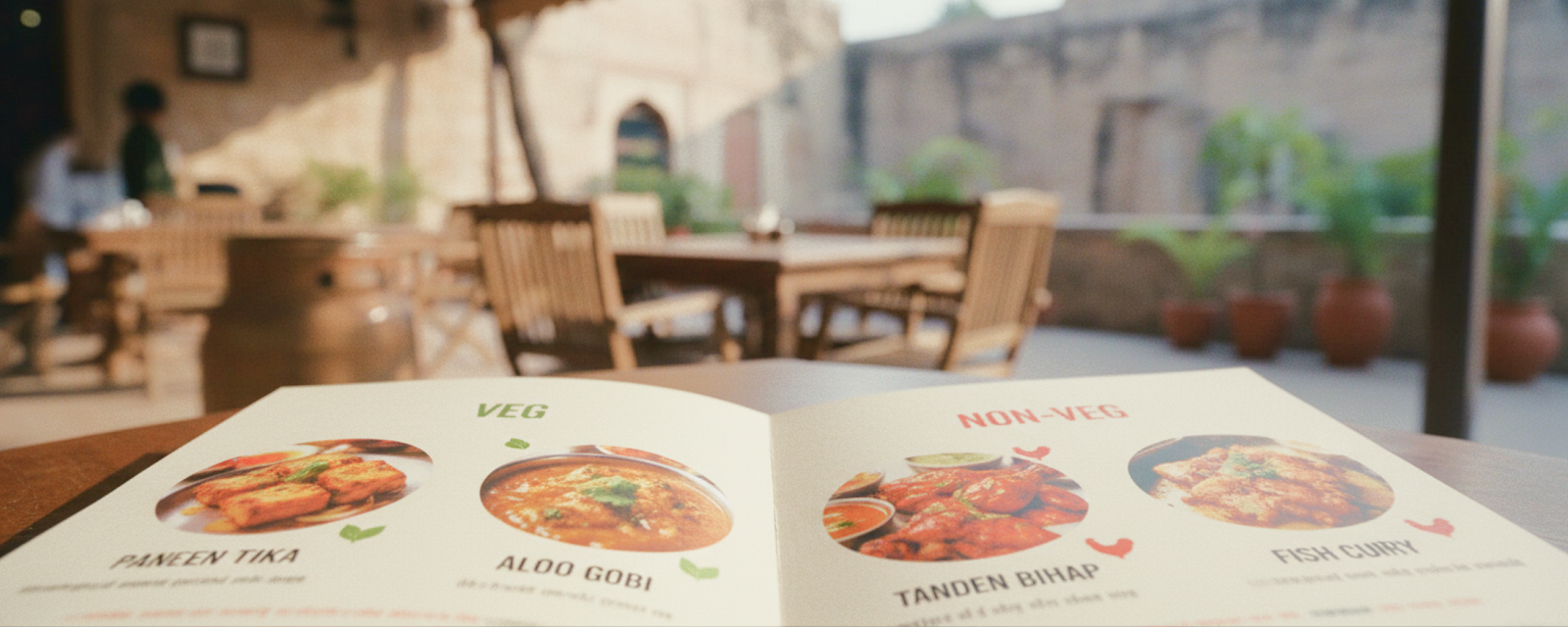
You sit down at a restaurant in India, the waiter hands you a menu, and suddenly you’re staring at four pages of words you’ve never seen before. Dal makhani. Appam. Kosha mangsho. Mirchi ka salan. It all sounds incredible — but where do you even begin?
Don’t panic. Indian menus can look overwhelming at first, but once you understand the basic structure and a few key terms, the whole thing clicks into place. And then the real fun begins: ordering everything you can.
Here’s your friendly, first-timer’s guide to reading an Indian menu with confidence.
Veg vs. Non-Veg: The First Thing to Look For
Before anything else, notice that most Indian menus are divided into vegetarian and non-vegetarian sections. This isn’t just a courtesy — it reflects how seriously India takes dietary choices, particularly for religious reasons.
You’ll spot small symbols next to each dish:
- 🟢 Green dot = vegetarian
- 🔴 Red dot = non-vegetarian
This system is legally required on all packaged food in India and widely used on menus too. It makes filtering your choices very easy, even before you know what anything is.
India has an extraordinary vegetarian food tradition — don’t feel like you’re missing out if you lean that way. Some of the most beloved dishes on any Indian menu are completely meat-free.
Breads: More Than Just Naan
Most tourists know naan, but Indian breads are a whole world of their own. Here’s a quick cheat sheet:
- Naan — Leavened, soft, slightly charred flatbread cooked in a tandoor (clay oven). The classic. Usually comes plain, buttered, or stuffed with garlic or cheese.
- Roti / Chapati — Thin, unleavened whole wheat bread. Lighter than naan and eaten daily in most Indian homes.
- Paratha — Flaky, layered flatbread, often stuffed with potato, paneer, or vegetables. A breakfast favourite in North India.
- Puri — Deep-fried bread that puffs up like a balloon. Usually served with dal or curry.
- Appam — A soft, lacy rice pancake from South India, slightly fermented and wonderfully light.
- Dosa — A thin, crispy crepe made from fermented rice and lentil batter. One of India’s greatest exports. Comes plain or stuffed — a masala dosa has a spiced potato filling inside.
First-timer tip: Order a bread alongside your main — it’s the perfect vehicle for scooping up curries and chutneys.
Curries & Mains: Decoding the Sauce
“Curry” is a catch-all term that covers an enormous range of dishes. On an Indian menu, the sauce style usually tells you a lot about what you’re getting:
- Makhani / Butter — Rich, creamy tomato-based sauce with butter and cream. Mild and crowd-pleasing. Butter chicken and dal makhani are the classics.
- Masala — A spiced tomato and onion base. Bolder than makhani. Chicken tikka masala is the most famous example.
- Korma — Mild, creamy, and slightly sweet, made with yoghurt or cream and cashews. Great for spice-sensitive palates.
- Vindaloo — Originating from Goa, this is fiery and tangy. A Portuguese-influenced dish with serious heat. Approach with respect.
- Saag / Palak — Spinach-based sauce. Saag paneer (spinach with Indian cottage cheese) and saag chicken are popular.
- Rogan Josh — A fragrant, deeply spiced Kashmiri curry, usually with lamb. Aromatic rather than fiery.
- Kadai / Karahi — Cooked in a wok-like vessel with bold, chunky spices and peppers. Rustic and flavourful.
- Dhal / Dal — Lentil-based dish. One of India’s most comforting staples. Every region has its own version — dal tadka is lightly spiced, dal makhani is rich and slow-cooked.
First-timer tip: If you’re unsure about spice levels, korma and makhani dishes are your safest starting point. If you love heat, ask for vindaloo or tell your waiter “I like it spicy” — they’ll know what to do.
Rice Dishes: Beyond Plain Rice
Plain steamed rice (chawal) is always available, but the rice dishes on an Indian menu can be meals in themselves:
- Biryani — The crown jewel of Indian rice dishes. Fragrant basmati rice slow-cooked with spices, saffron, and your choice of meat or vegetables. Every region does it differently — Hyderabadi biryani is arguably the most famous.
- Pulao / Pilaf — Lighter than biryani, rice cooked with whole spices, vegetables, or meat. More subtle in flavour.
- Jeera Rice — Plain rice tempered with cumin seeds. A simple, fragrant side dish that goes with everything.
- Khichdi — A comforting mix of rice and lentils, lightly spiced. India’s answer to comfort food.
Starters & Street Food Dishes
Many Indian restaurants list street food favourites as starters. These are worth exploring:
- Samosa — Crispy fried pastry filled with spiced potatoes and peas. An Indian institution.
- Pakora — Battered and fried vegetables, paneer, or chicken. Perfect with chai.
- Chaat — A category of tangy, sweet, spicy street snacks. Pani puri, bhel puri, and aloo chaat are the most common. Expect a flavour explosion.
- Tikka — Marinated chunks of meat or paneer cooked in a tandoor. Chicken tikka is smoky, tender, and deeply satisfying.
- Seekh Kebab — Spiced minced meat grilled on skewers. Rich and smoky.
Paneer: India’s Favourite Cheese
If you see paneer on the menu and you’re vegetarian — or even if you’re not — order it. Paneer is a fresh, firm Indian cheese that doesn’t melt when cooked, soaking up flavours beautifully. It appears across the menu in dozens of forms: paneer butter masala, palak paneer, paneer tikka, kadai paneer, and more.
Think of it as the vegetarian equivalent of chicken on an Indian menu — it goes with everything and is almost always delicious.
Understanding Spice Levels
Indian food has a reputation for being fiery, but the reality is more nuanced. Spice levels vary enormously by region and dish:
- Mild: Korma, makhani dishes, most South Indian coconut-based curries, biryani
- Medium: Masala dishes, rogan josh, most dals
- Hot: Vindaloo, Chettinad dishes (South India), many street food chutneys
Don’t be afraid to ask your waiter about spice levels — most restaurants are happy to adjust. Saying “medium spicy please” is completely normal and well understood.
If something turns out hotter than expected, raita (a cooling yoghurt condiment) or plain rice will be your best friends. Avoid reaching for water — it spreads the heat. Dairy is the real antidote.
Desserts: End on a Sweet Note
Indian desserts are rich, fragrant, and unlike anything in Western cuisine:
- Gulab Jamun — Soft, spongy milk-solid balls soaked in rose-scented sugar syrup. Dangerously good.
- Rasgulla — Light, spongy cheese balls in sugar syrup. A Bengali classic.
- Kulfi — Dense, slow-churned Indian ice cream. Comes in flavours like pistachio, mango, and rose.
- Kheer — Creamy rice pudding flavoured with cardamom and saffron. Pure comfort.
- Gajar ka Halwa — Slow-cooked carrot pudding with ghee, milk, and nuts. A winter favourite in North India.
- Jalebi — Crispy, syrup-soaked spirals of fried batter. Bright orange and wonderfully sticky.
First-timer tip: If you see gulab jamun on the menu, just order it. You can thank us later.
Paying the Bill
When you’re done feasting, paying is simple — most sit-down restaurants across India accept UPI payments, cards, and cash. If you’re using Mony for cashless UPI payments, restaurants are registered business accounts, so it works seamlessly. No currency fumbling, no mental maths on the exchange rate — just scan and pay.
One Last Thing
The best way to navigate an Indian menu is to ask questions and be adventurous. Tell your waiter what you like — whether that’s creamy, spicy, vegetarian, or something you’ve never tried before — and let them guide you. Indians are enormously proud of their food culture, and a curious, enthusiastic tourist is always welcome at the table.
Now go order the biryani. 🍛
Hungry for more India travel tips? Head to Mony Blogs — and travel cashless across India with Mony, UPI access for tourists made simple.



Leave a Reply