

If you’re wondering how to pay in India as a tourist, you’re not alone — and the answer might surprise you. Most visitors land expecting to tap their Visa at a street food stall in Delhi, only to be met with a QR code, a puzzled look, and the words “UPI hai?” (Do you have UPI?).
The truth is that India has leapfrogged card payments almost entirely. Over 21 billion UPI transactions were processed in January 2026 alone. From auto-rickshaw drivers to luxury hotels, nearly everyone expects digital payments — and the system they use, UPI, was designed for Indian bank accounts. Until recently, that left tourists stuck carrying wads of cash or hoping their international card would work. Fortunately, that’s changed.
This guide breaks down every payment option available to tourists visiting India in 2026: what works, what doesn’t, what it costs, and which combination gives you the smoothest trip.
The Short Answer
For tourists who need a quick answer on how to pay in India, here’s what works best:
- Primary method: A UPI wallet like Mony — works everywhere QR codes are displayed, which is almost everywhere. Set it up before you fly.
- Backup: A travel card from Wise or Revolut for ATM withdrawals and larger purchases at hotels and upscale restaurants.
- Emergency: ₹5,000–₹10,000 in cash for rural areas, tipping, and places with no connectivity.
Now, let’s break down each option in detail.
Payment Method 1: Cash (Indian Rupees)
How It Works
India’s currency is the Indian Rupee (₹ / INR). Notes come in ₹10, ₹20, ₹50, ₹100, ₹200, and ₹500 denominations. Coins exist but you’ll rarely use them.
Where to Get Cash
At the airport: Currency exchange counters are available at all international airports. Rates tend to be 3–5% worse than the mid-market rate, but they’re convenient for getting your first ₹2,000–₹5,000 to cover the taxi into the city.
ATMs: Available throughout cities. Stick to bank-owned ATMs inside branches — SBI, HDFC, ICICI, and Axis are all reliable. Avoid standalone ATMs in shops, and note that most dispense up to ₹10,000–₹20,000 per transaction.
Money changers: Licensed forex shops in tourist areas (Connaught Place in Delhi, Colaba in Mumbai, Fort Kochi) generally offer better rates than the airport. Always verify they’re RBI-authorised.
What It Costs
Cash is deceptively expensive. You’ll lose money at multiple points:
- Exchange rate markup: 2–5% worse than the real mid-market rate
- ATM withdrawal fees: Your bank may charge ₹200–₹500 per withdrawal, plus the Indian ATM operator may add ₹20–₹25
- Foreign transaction fees: Many banks charge an additional 1–3%
- Currency import limit: You can only bring ₹25,000 in cash into India
The Verdict
Keep ₹5,000–₹10,000 on you at all times as backup, but don’t rely on it as your primary method. Between fees and bad exchange rates, you could lose 4–8% of your travel budget.
Payment Method 2: International Credit & Debit Cards
How It Works
Visa and Mastercard are the most widely accepted networks. Amex and Diners Club have limited acceptance. You’ll be asked to tap, swipe, or insert your chip card at a POS terminal.
Where Cards Work — and Where They Don’t
Cards are accepted at upscale hotels and restaurants, shopping malls, branded retail stores, airlines, and some large grocery chains. However, they won’t get you far at street food vendors, auto-rickshaws, local cafés, markets and bazaars, pharmacies, train stations, temples, or monument entry points. In practice, cards work at roughly 20–30% of the places you’ll want to spend money.
The OTP Problem
Many Indian online platforms require a One-Time Password (OTP) sent to an Indian phone number to complete a card transaction. If you’re booking a train on IRCTC, ordering food on Zomato, or buying anything online, your international card may simply be rejected.
What It Costs
- Foreign transaction fee: 1.5–3% per transaction
- Dynamic Currency Conversion (DCC): Always decline — choose INR, not your home currency. DCC adds 3–7% in hidden fees.
- ATM cash advance fees: Using a credit card at an ATM is extremely expensive — a 3–5% fee plus interest from day one.
The Verdict
Bring a Visa or Mastercard as a backup for hotel bills and emergencies. Even so, don’t expect to get through a full day in India on cards alone — you’ll hit a wall quickly.
Payment Method 3: Forex / Travel Prepaid Cards
How It Works
Forex cards (also called travel cards) are prepaid cards you load with Indian Rupees before your trip, locking in an exchange rate. Providers include Wise, Revolut, Niyo, and various banks.
Advantages Over Regular Cards
Compared to standard international cards, travel cards offer better exchange rates (Wise uses the mid-market rate), lower fees (Wise charges ~0.6% conversion), and the ability to lock in a rate before your trip. They also tend to work more reliably at in-person POS terminals, with fewer OTP issues.
The Verdict
A Wise or Revolut card is the best backup payment method for tourists in India. Use it for ATM withdrawals and larger purchases — but it still won’t solve the QR code problem at 70% of vendors.
Payment Method 4: UPI — How Most Indians Actually Pay
How It Works
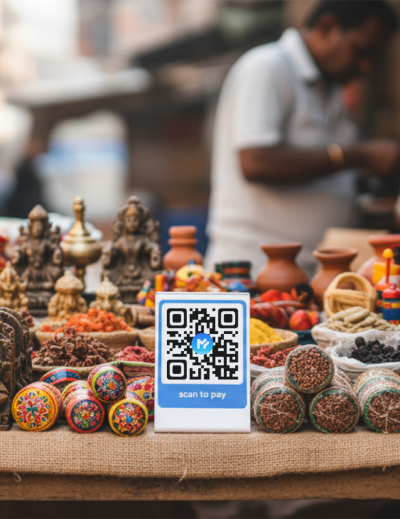
UPI (Unified Payments Interface) is India’s national digital payment system. It lets anyone send money instantly by scanning a QR code. No card needed, no cash needed — just open an app, scan the merchant’s QR code, enter your PIN, and the payment completes in under 3 seconds. UPI processed over 21.7 billion transactions worth approximately ₹28 lakh crore in January 2026 alone.
Why Tourists Couldn’t Use It Until Now
UPI was originally designed to link to an Indian bank account with an Indian phone number. Without both, tourists were locked out entirely — watching locals breeze through payments while fumbling with cash and getting incorrect change.
UPI One World: The Game-Changer
In 2023, India’s National Payments Corporation (NPCI) launched UPI One World — a prepaid wallet system that lets foreign tourists use UPI without an Indian bank account or phone number. Here’s how it works:
- Download an approved UPI One World app (like Mony)
- Complete KYC with your passport and visa details
- Load your wallet using your international debit or credit card
- Get a UPI ID and set a UPI PIN
- Scan any UPI QR code in India to pay instantly
Current limits: You can load up to ₹25,000 per transaction, with a monthly maximum of ₹50,000 (approximately $580 USD). Unused balance can be refunded to your original card.
Where UPI Works
The short answer: almost everywhere. Street food stalls and tea shops, auto-rickshaws and taxis, restaurants of all sizes, hotels and guesthouses, markets and bazaars, pharmacies, temples, monument entry tickets, Uber and Ola rides, and online apps like Zomato and Swiggy. If a business in India has a QR code — and nearly all of them do — you can pay with UPI.
What It Costs
This is UPI’s biggest advantage: zero transaction fees. No foreign transaction markup, no conversion spread. The exchange rate is applied once when you load your wallet, and every payment after that is free.
The Verdict
UPI is the best way to pay in India as a tourist in 2026. It works where cards don’t, it’s free where cash costs you fees, and with UPI One World apps like Mony, you no longer need an Indian bank account to use it.
Payment Method Comparison: At a Glance
| Cash | Int’l Card | Forex Card | UPI (Mony) | |
|---|---|---|---|---|
| Street food | ✅ | ❌ | ❌ | ✅ |
| Restaurants | ✅ | Some | Some | ✅ |
| Hotels | ✅ | ✅ | ✅ | ✅ |
| Rickshaws/taxis | ✅ | ❌ | ❌ | ✅ |
| Markets/shopping | ✅ | ❌ | ❌ | ✅ |
| Online bookings | ❌ | Limited | Limited | ✅ |
| Transaction fee | 3–8% hidden | 1.5–3% | 0.5–1% | 0% |
| Coverage | 100% | ~25% | ~25% | ~90% |
How to Set Up Mony Before Your Trip
The best time to set up your UPI wallet is before you board your flight to India. The entire process takes about 5 minutes — do it in the departure lounge.
- Download the Mony app from the App Store or Google Play.
- Sign up with your international phone number and email.
- Complete KYC by uploading your passport and visa details.
- Load your wallet using your international credit or debit card. Start with ₹10,000–₹15,000.
- Set your UPI PIN within the app.
- You’re ready. When you land, open Mony, scan any QR code, enter your PIN, and pay.
Recommended Payment Strategy
Before You Fly
- Download and set up Mony (5 minutes)
- Load ₹15,000 onto your wallet
- Get a Wise or Revolut travel card as backup
- Notify your bank of your travel dates to avoid card blocks
At the Airport in India
- Exchange $50–$100 worth of cash (₹4,000–₹8,000) for immediate needs
- Get a local SIM card (Airtel or Jio) for data and connectivity
Day to Day
- 90% of payments: Mony UPI — scan and pay everywhere
- Hotels and big bills: Travel card or international credit card
- Tipping and small emergencies: Cash
Before You Leave
- Spend down your cash or convert leftovers at the airport
- Any remaining Mony balance gets refunded to your original card
Common Questions About How to Pay in India as a Tourist
Can I use Apple Pay or Google Pay in India? Apple Pay has very limited acceptance in India. Google Pay works domestically but requires an Indian bank account and Indian phone number — it won’t work with your overseas account. For tourists, a UPI One World wallet like Mony is the right solution.
How much cash should I carry each day? Carry ₹1,000–₹2,000 as a daily cash backup alongside your UPI wallet. This covers tipping, the rare vendor without a QR code, and places with poor connectivity.
Is UPI safe to use in India? Yes. UPI is regulated by the Reserve Bank of India and uses PIN-based authentication for every transaction. Never share your UPI PIN with anyone — just as you wouldn’t share your bank PIN.
What if my phone battery dies? Always keep ₹1,000–₹2,000 in cash as backup. Consider carrying a portable power bank too — India is hot and batteries drain faster than you’d expect.
Can I tip with UPI? Yes. Many guides, drivers, and hotel staff now have personal UPI QR codes. That said, cash is still more practical for smaller tips of ₹50–₹100.
What about paying for trains? IRCTC (Indian Railways) is notoriously difficult with international cards. Having a UPI wallet makes booking trains significantly easier — pay directly through the IRCTC website or app using Mony.
What It Actually Costs: A Day in India
| Expense | Typical Cost | Best Payment |
|---|---|---|
| Airport taxi to hotel | ₹400–₹1,500 | UPI or cash |
| Breakfast at local café | ₹100–₹300 | UPI |
| Monument entry fee | ₹50–₹750 | UPI or cash |
| Auto-rickshaw ride | ₹30–₹150 | UPI or cash |
| Lunch at restaurant | ₹200–₹800 | UPI |
| Chai from a stall | ₹10–₹30 | Cash or UPI |
| Shopping at a bazaar | ₹200–₹5,000 | UPI |
| Dinner at nice restaurant | ₹500–₹2,000 | UPI or card |
| Hotel per night | ₹1,500–₹10,000 | Card or UPI |
Total typical daily spend: ₹2,500–₹8,000 ($30–$95 USD)
City-by-City: What Payment Looks Like on the Ground
Delhi: Highly digital. Chandni Chowk street vendors, metro stations, and cycle-rickshaw drivers in Old Delhi often accept UPI. Cards work at malls in Connaught Place and upscale Khan Market shops. Keep cash for tipping and narrow-lane riders without smartphones.
Jaipur: The bazaars around Hawa Mahal and Johari Bazaar are QR-code-heavy — you’ll scan to pay for block-print fabrics, gems, and street food. Amber Fort and most palace tickets accept UPI. Smaller textile shops still prefer cash for bargaining, though most will accept UPI once a price is agreed.
Goa: Beach shacks almost universally accept UPI. Scooter rentals, water sports operators, and the Saturday Night Market in Arpora are all UPI-friendly. North Goa is more digital; some remote South Goa beaches still lean on cash. Upscale restaurants in Panjim also accept cards.
Mumbai: India’s most card-friendly city — though even here, street food stalls at Mohammed Ali Road and local trains run on UPI and cash. Gateway of India vendors, Colaba Causeway shops, and most restaurants citywide accept all methods.
Hyderabad: The Old City around Charminar is a UPI stronghold. Pearl vendors, bangle shops, biryani joints, and street chai stalls all have QR codes. Banjara Hills restaurants accept cards readily, and Golconda Fort entry accepts UPI.
Varanasi: One of the more cash-dependent cities for tourists, particularly for boat rides on the Ganges and temple areas. UPI works at most established restaurants and shops, but have cash ready for ghats and narrow-lane vendors.
What Changed in 2026
As of February 2026, UPI One World is expanding rapidly. NPCI rolled out the wallet to international delegates at the India AI Impact Summit, enabling visitors from over 40 countries to use UPI at thousands of merchants without an Indian bank account. With a record 21.7 billion transactions processed in January 2026 alone, the infrastructure is only getting stronger.
The direction is clear: India is building its economy around UPI, and tourists who tap into it will always have a smoother experience than those relying on cash and cards alone.
The Bottom Line
Understanding how to pay in India as a tourist comes down to one key insight: India runs on UPI, not cards. The tourists who have the smoothest trips arrive with a UPI wallet already set up on their phone, cash as a backup, and a travel card for bigger purchases.
Download Mony before your flight. Load it up. When you land in India, you’ll pay for your rickshaw, your biryani, and your souvenirs the same way 1.4 billion Indians do — with a quick scan of your phone.




Leave a Reply