

If you’ve spent even a short time in India, you’ve heard the acronym everywhere. At shop counters, in cafés, from taxi drivers, at hotel desks, and from street vendors selling chai for ₹10. QR codes are taped to every surface. People casually ask, “UPI chalega?” (“Will that work?”) or “Scan kar do” (“Just scan it”).
So what is UPI, exactly? And why does an entire country of 1.4 billion people rely on it instead of cash and cards?
UPI — or Unified Payments Interface — is India’s national digital payment system. It’s a single network connecting every major bank and payment app, allowing anyone to send and receive money instantly using their phone. No cards, no cash, no account numbers required. Just scan a QR code, enter your PIN, and the money moves in under 3 seconds.
In January 2026 alone, Indians made over 21.7 billion transactions through the system, worth approximately ₹28 lakh crore. That’s not a niche technology — that’s how an entire nation pays for everything from a ₹10 cup of tea to a ₹10 lakh wedding venue.
And as of 2023, tourists can use it too.
How the System Works
The network connects your bank account to a mobile app. Rather than sharing long account numbers and IFSC codes, every user gets a UPI ID — a short address that looks like an email:
name@bank
For example: alex@upi or priya@oksbi
Think of it as a payment address. Someone sends money to your ID, or you scan their QR code, and funds move directly from one bank account to another — no wallet balance, no intermediary, no delay.
Once set up, the app lets you send and receive money instantly, pay in shops by scanning QR codes, book and pay online, split bills with friends, and transfer funds any time — including weekends and public holidays. The network runs 24/7, 365 days a year. Every transaction is authenticated with a personal PIN, similar to a bank PIN but used exclusively for these payments.
Is It a Wallet?
This is a common misconception worth clearing up. The system is not a wallet like Apple Pay or a prepaid card — it connects straight to your bank account, so money moves directly between banks rather than through a stored app balance.
There’s no topping up, no holding funds in an app, and your balance is always your real bank balance. When you pay ₹200 for lunch, that ₹200 leaves your bank account and lands in the restaurant’s bank account instantly.
The one exception is UPI One World for tourists, which does use a prepaid wallet model — more on that below.
Why It Took Over India
India didn’t just adopt this payment method — it leapfrogged cards entirely. Most Indians went straight from cash to mobile payments without ever regularly using credit or debit cards for daily purchases. Several factors explain why.
Speed. Money moves in under 3 seconds, every time. There are no pending transactions, no settlement delays, no business-day processing windows to wait for.
Zero fees. Transactions carry no charges for consumers — no foreign transaction fees, no processing surcharges. The cost is absorbed entirely by the banking system.
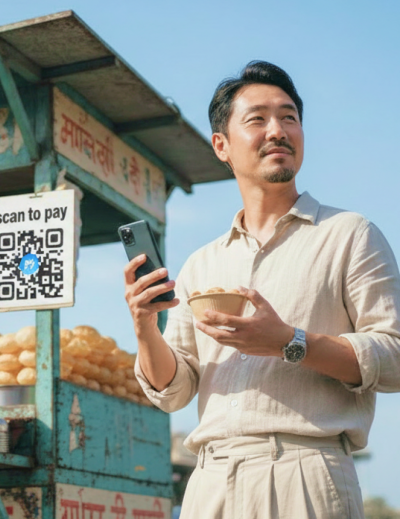
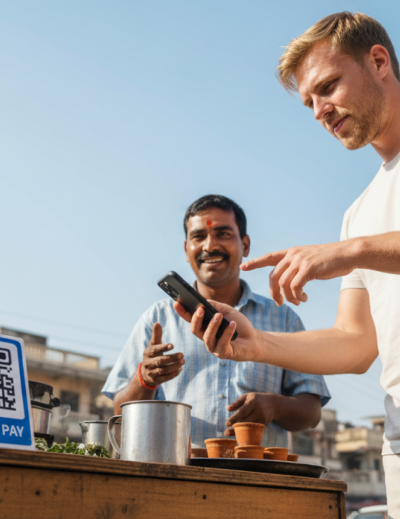
Near-universal acceptance. From five-star hotels to a roadside coconut seller, if a business has a smartphone and a bank account, it can accept payments. Merchants don’t need expensive POS terminals; a printed QR code is enough.
Simplicity. Open the app, scan the QR code, enter the amount, confirm with your PIN — four steps, under 10 seconds. No fumbling for change, no waiting for a card machine to connect.
Round-the-clock availability. Bank holidays, Sundays, 3 AM — it doesn’t matter. The network never closes.
Bank-grade security. Every payment requires a personal PIN, and the system is regulated by the Reserve Bank of India (RBI) and the National Payments Corporation of India (NPCI), protecting hundreds of millions of accounts.
What People Use It For
This payment method is woven into every part of daily life in India.
Shopping: Stores, markets, malls, and local vendors all accept it. Whether you’re buying silk in Varanasi or electronics in Bangalore, the QR code is right there on the counter.
Food and drinks: Restaurants, cafés, street food stalls, and delivery apps like Zomato and Swiggy. You’ll pay for your biryani in Hyderabad and your filter coffee in Chennai the same way — scan and pay.
Getting around: Taxis, auto-rickshaws, Uber, Ola, metro cards, and even parking meters. In cities like Delhi and Mumbai, many rickshaw drivers have a QR code taped to the back of their seat.
Travel: Hotels, guesthouses, tour bookings, experience operators, and monument entry tickets — increasingly including government-run sites.
Online payments: E-commerce, subscriptions, bill payments, insurance premiums, and train tickets on IRCTC all support the system.
Sending money: Splitting a dinner bill, paying back a friend, sending money to family — all instant, all free.
If people are paying for something in India, this is almost certainly how they’re doing it.
QR Codes and How They Connect
QR codes are central to the network’s success. They’re the reason a street vendor with no card machine can accept digital payments from anyone.
The process is straightforward:
- Open your app
- Scan the merchant’s QR code
- Enter the amount
- Confirm with your PIN
No machines, no cards, no signatures. The merchant gets a confirmation within seconds — you’ll hear a satisfying “payment received” chime from their speaker. Because every QR code is tied to a specific bank account, funds go directly where they need to. Merchants print their code once and it works indefinitely, which is why you’ll see them laminated on counters, walls, and auto-rickshaw dashboards alike.
How International Visitors Can Pay in India
For years, the system was locked to people with Indian bank accounts and Indian phone numbers. Tourists were stuck watching locals breeze through payments while fumbling with cash and hoping their international card wouldn’t get rejected.
That changed in 2023, when NPCI launched UPI One World — a prepaid wallet system designed specifically for foreign visitors. It lets tourists access India’s payment network without an Indian bank account or phone number.
The Prepaid Wallet Model Explained
Unlike the standard version, UPI One World uses a prepaid wallet. You load money using your international card, then spend it at any QR code in India. Here’s the setup:
- Download an approved UPI One World app (like Mony)
- Complete KYC with your passport and visa details
- Load your wallet using your international debit or credit card
- Set your PIN
- Scan any QR code in India to pay
The entire process takes about 5 minutes and can be completed before you board your flight.
Why This Matters for Travellers
Before UPI One World, tourists had three payment options — and none of them were great.
Cash meant losing 4–8% to exchange rate markups and ATM fees, carrying large amounts of rupees, and constantly hunting for money changers.
International cards only worked at roughly 25% of places tourists actually want to spend money. Street food stalls, rickshaws, and markets don’t have POS terminals. Moreover, many Indian online platforms reject foreign cards because they require an Indian OTP (one-time password).
Forex and travel cards (Wise, Revolut) offer better exchange rates but face the same acceptance problem — they only work where card machines exist.
With this tourist wallet, visitors can pay at roughly 90% of businesses in India, including all the places where cards fail. Furthermore, since transactions carry zero fees, you’re not losing money on every purchase.
Mony: The Tourist-Friendly Way to Pay
Mony is a UPI One World app built specifically for international tourists visiting India. Listed on the NPCI website as an approved issuer, it’s one of the authorised apps giving tourists full access to India’s payment network using just a passport and an international card.
What sets Mony apart:
- 5-minute setup using your passport and visa — no Indian bank account or SIM needed
- Load your wallet with any international Visa, Mastercard, or compatible card
- Pay at any QR code — the same ones 1.4 billion Indians use daily
- Zero transaction fees on payments
- Unused balance refunded to your original card when you leave
- Works online too — book trains on IRCTC, order food on Zomato, pay for Uber rides
Download Mony before your trip and arrive in India ready to pay like a local from the moment you land.
Comparing Your Payment Options as a Tourist
Here’s how the four payment methods available to tourists in India stack up:
| Cash | Int’l Card | Forex Card | UPI (Mony) | |
|---|---|---|---|---|
| Street food & tea stalls | ✅ | ❌ | ❌ | ✅ |
| Restaurants | ✅ | Some | Some | ✅ |
| Hotels | ✅ | ✅ | ✅ | ✅ |
| Rickshaws & taxis | ✅ | ❌ | ❌ | ✅ |
| Markets & bazaars | ✅ | ❌ | ❌ | ✅ |
| Online bookings | ❌ | Limited | Limited | ✅ |
| Transaction fees | 3–8% hidden | 1.5–3% | 0.5–1% | 0% |
| Setup needed | Find ATM/exchanger | None | Pre-trip signup | 5 min app setup |
| Acceptance | ~100% | ~25% | ~25% | ~90% |
| Main risk | Theft, bad rates | OTP rejection | Card rejection | Phone battery |
For a deeper breakdown including costs, setup instructions, and city-by-city guides, read our complete guide: How to Pay in India as a Tourist (2026).
Security and Safety
Yes, the system is safe. It’s built on India’s regulated banking infrastructure and overseen by the RBI and NPCI.
Every transaction requires a personal PIN — a 4 or 6-digit code that only you know. Without it, no payment can go through, so even if someone has your phone, they can’t make payments. Additionally, the network uses end-to-end encryption and secure banking channels — the same infrastructure that protects over a billion Indian bank accounts.
One rule to remember: never share your PIN with anyone. No legitimate business, bank, or payment app will ever ask for it. Treat it exactly like your bank PIN.
A Growing Global Network
What is UPI becoming beyond India’s borders? Increasingly, a global model for how digital payments should work.
As of early 2026, the system is accepted at merchants in Singapore, the UAE, France, Sri Lanka, Bhutan, Nepal, and Mauritius, with more countries being added regularly. India’s government is actively pushing for interoperability with payment systems across Southeast Asia, the Middle East, and Europe.
UPI One World is also expanding rapidly. NPCI rolled it out to international delegates at the India AI Impact Summit in February 2026, and both the number of approved apps and supported countries continue to grow. Consequently, tourists who use it today are tapping into infrastructure that will only get stronger over time.
The Bottom Line
So, what is UPI? In short: it’s how modern India pays. It’s fast, free, secure, and accepted almost everywhere — from luxury hotels to roadside tea stalls.
For locals, it’s second nature. For businesses, it’s the standard. And for tourists, it’s now accessible through the UPI One World scheme via apps like Mony.
Setting up a tourist wallet before your trip is, therefore, the single best thing you can do to make daily spending easier in India. Download Mony, complete the 5-minute setup, and you’ll pay for your rickshaw, your biryani, and your souvenirs the same way 1.4 billion Indians do — with a quick scan of your phone.





Leave a Reply