
Jaipur’s Timeless Charm: Exploring the Top 5 Famous Parks in Jaipur
Spend even one afternoon in Jaipur‘s honking traffic and sun-baked bazaars, and you’ll quickly understand why the city’s parks feel like a small miracle. Tucked between sandstone monuments and crowded market lanes, these green spaces offer something the Pink City’s famous forts simply can’t — quiet. So whether you’re a solo traveller needing a breather, a family looking for a picnic spot, or a morning jogger passing through, this guide has you covered. Here are five parks in Jaipur genuinely worth your time.
Ram Niwas Garden — Jaipur’s Green Heart Since 1868
Built in 1868 by Maharaja Sawai Ram Singh, Ram Niwas Garden is arguably the most historically layered park in the city. It was created partly as a famine relief project. The Maharaja employed locals to build it during a particularly difficult drought year. Even today, that sense of civic purpose seems to linger in the atmosphere. As a result, it feels less like a tourist attraction and more like a place that genuinely belongs to the city.
The star attraction inside the garden is the Albert Hall Museum — Rajasthan’s oldest museum. It is housed in a stunning Indo-Saracenic building that looks even better after dark when illuminated. Inside, you’ll find royal costumes, ancient coins, Persian carpets, miniature paintings, and — genuinely — an Egyptian mummy. It’s worth at least two hours on its own.
In addition to the museum, the garden also contains a zoo, a bird park, and a greenhouse. That makes it a solid half-day option if you’re travelling with children.
Practical info
- Timings: Garden open daily, sunrise to sunset. Albert Hall Museum: 9:00 AM – 8:00 PM (last entry 7:30 PM)
- Entry fee (garden): Free
- Albert Hall Museum entry: ₹40 for Indian adults | ₹300 for foreign nationals | ₹20 for students (Indian) | ₹150 for students (foreign)
- Getting there: The nearest metro station is Choti Chaupar on the Pink Line — about a 10-minute auto-rickshaw ride from there. An auto from the Old City should cost ₹50–80. Taxis via Ola/Uber typically run ₹100–150 from central Jaipur.
- Food nearby: The garden is close to MI Road (5–10 min), where you’ll find Lassiwala (iconic lassi, ₹30–50 per glass) and Rawat Mishthan Bhandar for kachoris and pyaaz ki kachori (₹20–30 per piece).
Sisodia Rani Ka Bagh — A Royal Garden Built for Love
About 8 km from the city centre on the Agra Road, Sisodia Rani Ka Bagh feels like a different world. It was built in 1728 by Maharaja Sawai Jai Singh II for his queen from the Sisodia clan of Udaipur. The garden was designed as a private retreat — somewhere the queen could escape the politics and noise of the city palace. Nearly 300 years later, it still has that feeling.
The layout follows a classic Mughal style, spread across multiple terraced levels. Cascading fountains, water channels, and pavilions are connected by shaded walkways. However, what truly sets it apart from other gardens in the city are the vivid painted murals on the pavilion walls. These depict detailed scenes from the life of Lord Krishna and Radha, rendered in bold, unfaded colours. They’re genuinely beautiful, and you’ll want to take your time with them.
Furthermore, the surrounding Aravalli hills frame the garden beautifully — particularly good for photography in the cooler morning hours. Don’t rush this one. It rewards slow walking.
Practical info
- Timings: Daily, 8:00 AM – 8:00 PM
- Entry fee: ₹50 for Indian nationals | ₹200 for foreign nationals | Free for children under 7
- Getting there: No metro access nearby — this one requires a road trip. An Ola/Uber from central Jaipur costs around ₹150–200 one way. Auto-rickshaws will often quote ₹200–250; negotiate. Some drivers try to overcharge — agree on a fare before you get in, or use the app.
- Best time to visit: Early morning (8–10 AM) for soft light and fewer crowds, or late afternoon when the tilework catches the golden hour.
- Food nearby: There’s a small canteen inside the garden grounds for chai and snacks. For a proper meal, head back towards town — Ghat Ki Guni Road has several dhabas with thali meals for ₹80–120.
Central Park Jaipur — 129 Acres of Pure, Unhurried Space
Opened in 2006 and built by the Jaipur Development Authority, Central Park is the largest park in the city — stretching over 129 acres along Prithviraj Road. It’s where the city goes to breathe. On any given morning you’ll find retired couples power-walking the 5.5 km jogging track, yoga groups on the lawns, and children feeding birds near the ponds. It has four entrance gates and the kind of easy, non-touristy vibe that makes it a great place to just exist for an hour without an agenda.
The park is particularly popular with fitness-minded visitors — the jogging and cycling tracks are well-maintained and clearly marked. There’s also a 9-hole golf course inside the park (the only one in central Jaipur), a musical fountain that comes alive in the evenings, and a flag mast that flies one of India’s tallest national flags. Birdwatchers will enjoy the park too — both resident and migratory species frequent the larger trees and water features.
Practical info
- Timings: Daily, 5:00 AM – 9:00 PM
- Entry fee: Free (golf course charges separately; approx. ₹300–500 per round for non-members)
- Getting there: The nearest metro station is Sawai Man Singh Hospital on the Pink Line — the park is a short 5-minute walk from there. This is one of the easiest parks to reach by public transport in Jaipur.
- Food inside the park: A few small kiosks near the main gates sell chai (₹10–15), corn on the cob (₹20–30), and packaged snacks. Nothing elaborate — bring your own water.
- Food nearby: The park sits close to C-Scheme, Jaipur’s café district. More casual options on Tonk Road include multiple fast-food joints and bakeries.
Jawahar Circle Garden — Evening Fountains & Asia’s Largest Circular Park
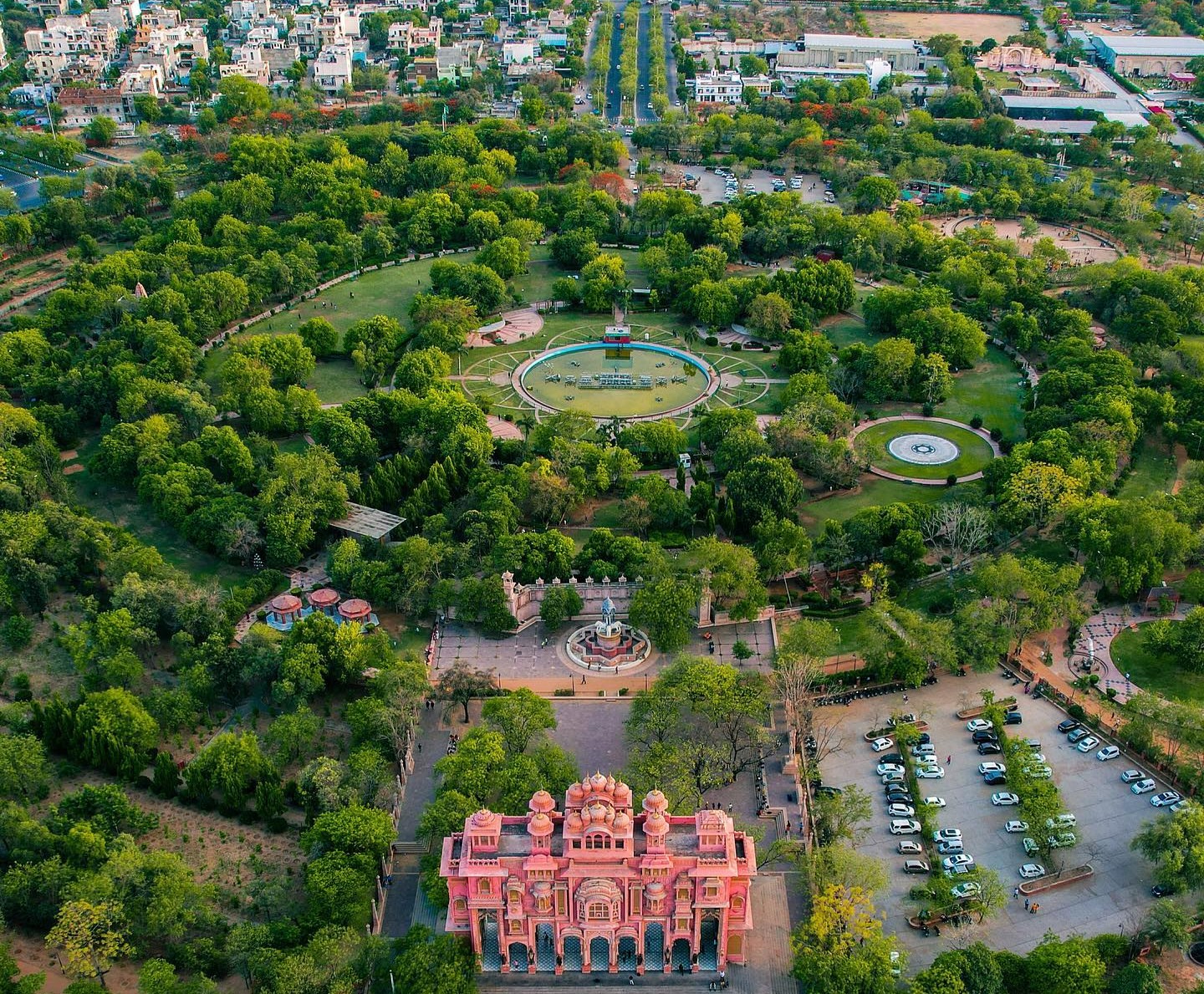
Jawahar Circle Garden sits on the southern end of Jaipur near Tonk Road, and it makes a strong first impression — from above, the concentric circular layout is impressive enough to be visible on satellite maps. It’s widely cited as the largest circular park in Asia, though you’d be forgiven for just calling it lovely and leaving it at that.
The garden is best visited in the evening. That’s when the musical fountain show runs (usually 7:00 PM – 8:30 PM), set to classical and folk music with colour-changing water jets. It’s free to watch, draws a proper crowd, and is genuinely enjoyable rather than gimmicky. The well-maintained rose garden at the centre is also worth a slow walk — dozens of rose varieties are planted here and they’re at their best between November and February.
The wide jogging track around the perimeter is popular for evening walks, and the whole park has a well-lit, safe feeling after sunset that many parks in the city don’t quite manage.
Practical info
- Timings: Daily, 6:00 AM – 10:00 PM
- Entry fee: Free
- Musical fountain show: Evenings, approximately 7:00 PM – 8:30 PM (subject to seasonal changes; confirm locally)
- Getting there: Located near Tonk Road, opposite Jawahar Kala Kendra. No direct metro access — take an auto or app-based cab from the city centre (₹120–180 from the Pink Line’s southern stations). Autos from Sindhi Camp bus stand: ₹100–130.
- Food nearby: The stretch of Tonk Road near Jawahar Circle has several good options — Handi Restaurant for Rajasthani thali (₹150–250), and multiple street food carts selling kulfi, bhel puri, and pav bhaji in the evenings right outside the park gates (₹30–60 per item).
Jaipur Central Park (Nehru Garden) — The City’s Quiet Cultural Corner
Not to be confused with the larger Central Park on Prithviraj Road, this smaller park — often called Nehru Garden locally — is a neighbourhood favourite in the heart of the city. It’s quieter, less manicured, and more lived-in than the others on this list, which is precisely what makes it charming. You’ll find the kind of regulars who sit on the same bench every morning, families having impromptu picnics on Sundays, and local artists occasionally sketching near the statues.
The park has a modest but appealing collection of sculptures and stone artworks placed throughout the grounds, giving it a mild gallery feel as you walk through. It’s also a reliable spot for bird watching — the large trees attract mynas, parakeets, sunbirds, and during winter, a handful of migratory species. If you’re a birder with binoculars and an early morning hour to spare, it’s well worth the stop.
The park occasionally hosts cultural events, small food festivals, and community gatherings, particularly around national holidays — if your visit coincides with one, it’s a lovely slice of local life.
Practical info
- Timings: Daily, 6:00 AM – 9:00 PM
- Entry fee: Free
- Getting there: Centrally located; accessible from most areas of Jaipur by auto (typically ₹60–100 from the walled city). The Civil Lines metro station on the Pink Line is the closest stop.
- Food nearby: Being centrally located, there’s no shortage of options. Anokhi Café on KK Square (10 min away) is a good spot for coffee and a light snack (₹150–300). Street food carts near the park entrance sell chai and samosas throughout the day (₹10–25).
Quick Reference: Jaipur Parks at a Glance
| Park | Entry Fee | Best Time to Visit | Nearest Metro |
|---|---|---|---|
| Ram Niwas Garden | Free (museum ₹40–300) | Morning or evening | Choti Chaupar |
| Sisodia Rani Ka Bagh | ₹50–200 | Early morning | No metro — cab/auto |
| Central Park | Free | Early morning or evening | SMS Hospital |
| Jawahar Circle Garden | Free | Evening (fountain show) | No metro — cab/auto |
| Jaipur Central Park (Nehru Garden) | Free | Morning | Civil Lines |
A Few Tips Before You Go
Jaipur’s summers (April–June) are brutal — daytime temperatures regularly cross 42°C. If you’re visiting then, stick to early morning (before 9 AM) or late evening visits. The best season for parks is October to February, when the weather is mild, the roses at Jawahar Circle are blooming, and long afternoon walks are genuinely pleasant.
Most parks don’t have ATMs inside, so carry cash — or use a scan-and-pay app like Mony — for entry fees, autos, and street food. The Jaipur Metro (Pink Line, running from Mansarovar to Badi Chaupar) is clean, affordable (₹10–45 depending on distance), and the easiest way to reach the city-centre parks — get the smart card for convenience if you’re in town for a few days.
Finally, a word on timing: mornings before 9 AM and evenings after 5 PM are when these parks are at their most alive. That middle stretch of the day, especially in summer, is mostly for dogs and very dedicated joggers.
Leave a Reply