
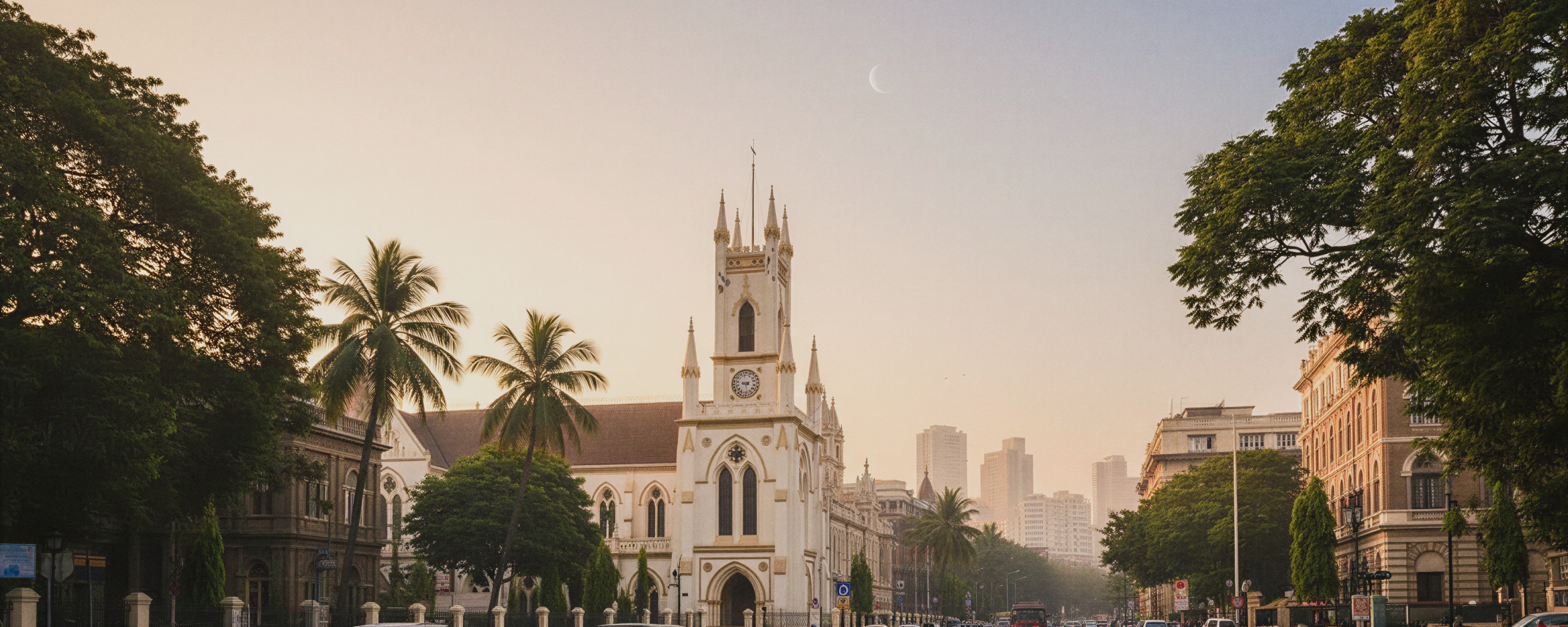
Mumbai isn’t just a city—it’s a living museum of architecture, where every corner tells a different story. From crumbling colonial facades to glittering glass towers, the city reveals its layered past and present through design. Walking through Mumbai feels like flipping through a visual history book—one where every chapter is written in stone, steel, and imagination.
Colonial echoes in Fort and Ballard Estate
Begin your journey in Fort, the historic heart of old Bombay, where colonial ambition still stands tall. The Chhatrapati Shivaji Maharaj Terminus (CST), a UNESCO World Heritage Site, is an extraordinary example of Indo-Gothic architecture. With its stained glass windows, ornate domes, turrets, and intricate stone carvings, it rivals some of Europe’s most iconic cathedrals.
Just a short walk away, St. Thomas Cathedral—built in 1718—offers a quieter glimpse into Mumbai’s earliest British roots, its vaulted ceilings echoing centuries of history. Continue towards Ballard Estate, where wide boulevards and Edwardian neo-classical buildings transport you to early 20th-century London. Here, symmetry, columns, and colonial order sit strikingly amidst Mumbai’s everyday chaos.
Art Deco dreams along Marine Drive
Following the sweeping curve of Marine Drive brings you into the glamour of the 1930s. Mumbai’s Art Deco district—second only to Miami in scale—is defined by clean geometric lines, curved balconies, and a sense of jazz-age optimism. The iconic Eros Cinema, with its vertical fins and stone façade, stands as one of the finest examples of Deco design in the city.
Nearby, the Oval Maidan offers one of Mumbai’s most dramatic architectural contrasts. On one side rise elegant Art Deco apartment blocks adorned with tropical motifs; on the other, the Gothic spires of the University of Mumbai and the Bombay High Court dominate the skyline. As the sun sets, this stretch becomes effortlessly cinematic.
Victorian Bombay in Byculla
In Byculla, Mumbai’s Victorian past comes into sharper focus. The Dr. Bhau Daji Lad Museum, established in 1872, is a beautifully restored Palladian structure with iron-and-glass interiors. Inside, detailed dioramas, maps, and decorative arts reveal the everyday life of 19th-century Bombay.
Step outside into Rani Baug, the city’s historic botanical garden and zoo, where colonial dreams of tropical grandeur still linger. Rare trees, old pathways, and iron pavilions make this area feel like a forgotten chapter of the city.
Bandra’s softer heritage and creative present
Across the sea, Bandra tells a gentler architectural story. Its Indo-Portuguese heritage lives on in narrow lanes, weathered bungalows, and quiet chapels. Mount Mary Basilica rises above the suburb with Baroque elegance, while the lanes of Ranwar Village preserve Bandra’s oldest residential pockets.
Yet Bandra is equally rooted in the present. Chapel Road and Waroda Road burst with street art, bold murals, and indie cafés, where creativity spills onto walls once marked by history. Here, the past and present don’t compete—they coexist, often on the same façade.
Mumbai’s future skyline in Worli and BKC
To see where Mumbai is headed, look to Worli and the Bandra-Kurla Complex. The Bandra-Worli Sea Link cuts across the Arabian Sea like a steel ribbon, symbolising the city’s engineering ambition. Nearby, soaring high-rises such as The World Towers reshape the skyline with glass and concrete confidence.
In BKC, sleek commercial blocks and avant-garde spaces like the Jio World Centre introduce a futuristic architectural language. These aren’t just business districts—they redefine the visual rhythm of modern Mumbai.
A city built in layers
What truly sets Mumbai apart is how these worlds collide and coexist. A centuries-old cross may stand at the base of a skyscraper, or a historic courtroom might re-emerge as a boutique bookstore. This isn’t just urban growth—it’s a city in constant dialogue with itself.
And as you explore it all, Mony keeps your payments effortless—whether you’re buying museum tickets, grabbing street-side nimbu pani, or picking up a coffee-table book on Mumbai’s architecture. Because in a city where every step tells a story, your journey should never have to pause.


Leave a Reply