
Table of Contents
The Ellora Caves represent one of the most ambitious construction projects in human history. This Ellora Caves travel guide gives you the context to appreciate why. Artisans carved 34 rock-cut temples and monasteries into the Charanandri hills of Maharashtra between the 6th and 10th centuries CE. The result documents three distinct religious traditions — Buddhism, Hinduism, and Jainism — built within a single hillside over several hundred years. UNESCO listed the site in 1983. The scale of what craftspeople accomplished here, using only hand tools across generations, makes Ellora one of the most genuinely awe-inspiring sites in India.
History and Context
Different dynasties built the caves across several centuries. The Rashtrakutas contributed the most spectacular Hindu caves, including the Kailasa Temple. Unlike the Ajanta Caves, which document a single religious tradition, Ellora shows three major religions competing to produce the most impressive sacred architecture possible. The site sat on an ancient trade route. Consequently, it attracted both resources and wealthy patrons. Buddhist caves came first, followed by Hindu, then Jain — though the timelines overlap and the groupings reflect religious affiliation rather than strict chronology.
The Buddhist Caves — Caves 1 to 12
The Buddhist section of the Ellora Caves contains the earliest structures on the site. Cave 10, the Vishvakarma Cave or Carpenter’s Cave, is the highlight. Its prayer hall has a ribbed vaulted ceiling that mimics wooden construction — a deliberate reference to earlier structures that no longer survive. A large seated Buddha faces visitors as they enter. Cave 12, called Tin Thal, is a three-storey monastery — the largest Buddhist cave at Ellora — with rows of seated Buddha images on each floor. These caves carry a simpler, more restrained aesthetic than what follows in the Hindu section.
The Hindu Caves — Caves 13 to 29
Kailasa Temple — Cave 16
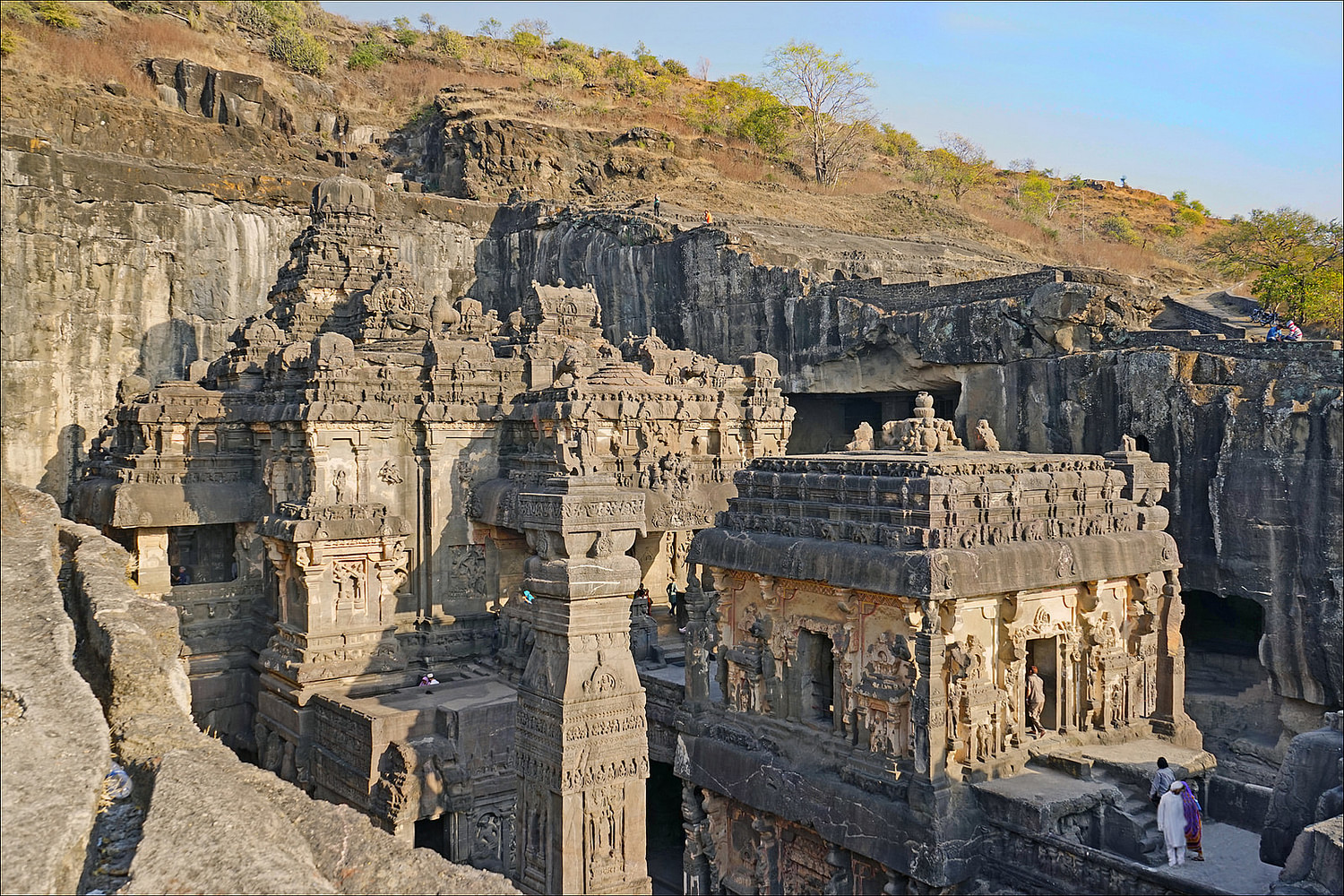
Cave 16, the Kailasa Temple, is the reason most visitors make the journey to Ellora. The Rashtrakuta king Krishna I commissioned it in the 8th century CE. Artisans carved the entire complex — a main shrine, subsidiary shrines, elephants, a gateway, and open courtyards — downward from the top of a single basalt outcrop. The result is the largest monolithic structure in the world. The sculptural programme covers scenes from the Ramayana, the Mahabharata, and the myths of Shiva and Vishnu. No photographs adequately convey the scale. Allow at least 90 minutes here alone.
Other Notable Hindu Caves
Cave 21, Ramesvara, contains some of the finest figural sculpture at Ellora. A celebrated Ganga and Yamuna panel flanks the entrance, and a large Nataraja relief covers the inner walls. Cave 29, Dhumar Lena, is a large cruciform cave with impressive Shaivite sculptures. Its plan closely recalls the Elephanta Caves near Mumbai.
The Jain Caves — Caves 30 to 34
The Jain caves at the northern end of the site date from the 9th and 10th centuries. They are the most ornate in terms of surface decoration. Cave 32, Indra Sabha, is the finest. It is a two-storey cave with elaborately carved ceilings, an exceptional lotus panel, and figures of the Jain tirthankaras surrounded by celestial attendants. The density and precision of the carving here exceeds anything in the Buddhist or Hindu sections. Cave 34 connects to Cave 33 through an internal passage. Together, they form a continuous sacred complex worth exploring in sequence.
Practical Information
Entry Fees and Timings
The Ellora Caves open Tuesday to Sunday from 6:00 AM to 6:00 PM. Authorities close the site on Tuesdays. Entry costs Rs 40 for Indian nationals and Rs 600 for foreign visitors. The Kailasa Temple entry is included in the standard ticket. Visitors may photograph throughout the site. Allow a full day — five to six hours minimum — to cover all three religious sections properly.
Getting There
Ellora sits approximately 30 kilometres from Aurangabad. Buses depart regularly from Aurangabad Bus Stand and take about 45 minutes at Rs 30 to Rs 50 per person. A private cab costs Rs 800 to Rs 1,200 for a return trip. Aurangabad Railway Station connects to Mumbai, Pune, and other major cities. Many visitors, moreover, combine Ellora with Aurangabad’s Bibi Ka Maqbara in a single day.
Food at the Site
A canteen near the main entrance serves basic meals for Rs 80 to Rs 200 per person. Several small restaurants operate in the village just outside the site. Pack water, as the walk between the Hindu and Jain cave sections is exposed and becomes hot in summer.
Tips for Your Visit
Start at the Kailasa Temple as soon as the gates open. It attracts the largest crowds by mid-morning, so early access makes a significant difference. Work through the Hindu caves first, then double back to the Buddhist caves. Finish at the Jain caves in the afternoon, when the light entering the carved interiors is at its best. An audio guide is available at the entrance for Rs 120 and provides useful context for the sculptural programmes throughout the site.
For NRI visitors and international tourists, Mony keeps all payments at the site and in Aurangabad seamless. Mony is a travel finance app that lets NRIs and tourists pay like locals using UPI. As a result, there are no foreign card fees and no complications at entry counters or roadside food stalls. This Ellora Caves travel guide recommends combining the visit with Ajanta if you have two days — together, the two sites represent the peak of ancient Indian rock-cut architecture.




Leave a Reply