
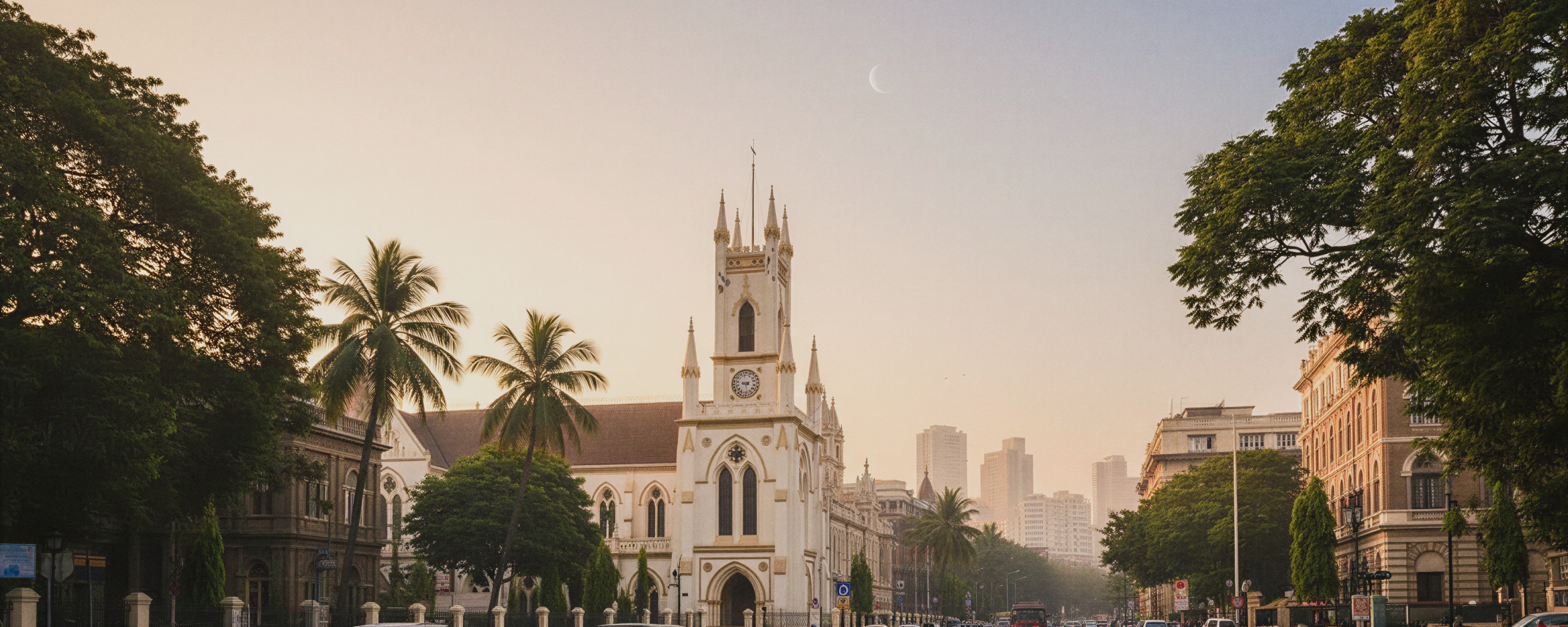
Mumbai is a living museum of architecture. A Mumbai architecture tour takes you through colonial Gothic cathedrals, jazz-age Art Deco apartment blocks, Edwardian trading estates, and Indo-Portuguese chapels — all within the same city, often within the same neighbourhood. Every building adds another layer to a story that spans four centuries. Additionally, the contrasts are what make it genuinely extraordinary: glass towers rising beside crumbling Victorian facades, street art covering the walls of 19th-century warehouses.
Colonial Echoes in Fort and Ballard Estate
Start any mumbai architecture tour in Fort, the historic core of old Bombay. The most dramatic opening statement is the Chhatrapati Shivaji Maharaj Terminus — a UNESCO World Heritage Site and one of the finest examples of Indo-Gothic architecture anywhere in the world. Its stained glass windows, ornate domes, turrets, and intricate stone carvings rival the great Victorian railway stations of Europe. It also functions as a working station, which means you can walk through it at any hour without paying an entry fee. The experience of standing inside while thousands of commuters rush past is, in itself, worth the visit.
A short walk away, St. Thomas Cathedral — built in 1718 — offers a quieter version of Mumbai’s British past. Its vaulted ceilings and memorial plaques feel contemplative rather than monumental. Entry is free and it opens daily from 7:00 AM to 6:00 PM. Continue from there towards Ballard Estate, where wide boulevards and Edwardian neo-classical buildings create an atmosphere closer to early 20th-century London than modern Mumbai. Symmetrical facades, stone columns, and an almost eerie orderliness make it one of the most photogenic parts of the city, particularly in the morning before traffic builds.
Art Deco Dreams Along Marine Drive
Mumbai’s Art Deco district is the second largest in the world after Miami. Consequently, it forms an essential section of any serious Mumbai architecture tour. The buildings along and behind Marine Drive date primarily from the 1930s and 1940s, defined by clean geometric lines, curved balconies, and decorative motifs that mix European Modernism with Indian tropical detail.
The Eros Cinema on Churchgate is one of the finest examples — its vertical stone fins and streamlined facade have survived largely intact and still function as an active cinema. Tickets for screenings cost Rs 150 to Rs 300 and offer a reason to step inside rather than simply photograph the exterior. Further along, Oval Maidan provides one of Mumbai’s most striking architectural contrasts. Art Deco apartment blocks line one side, while the Gothic spires of the University of Mumbai and the Bombay High Court dominate the other. At sunset, this stretch becomes particularly atmospheric.
Victorian Bombay in Byculla
Byculla brings the Victorian layer of Mumbai into sharper focus. The Dr. Bhau Daji Lad Museum, established in 1872, is a beautifully restored Palladian building with original iron-and-glass interiors. Inside, dioramas, maps, and decorative arts document the everyday life of 19th-century Bombay. Entry costs Rs 10 for Indian nationals and Rs 100 for foreign visitors. The museum opens Wednesday to Monday from 10:00 AM to 5:30 PM and closes on Tuesdays.
Outside, Rani Baug — the city’s historic botanical garden and zoo — surrounds the museum with old pathways, rare trees, and iron pavilions that carry a colonial sense of tropical grandeur. Entry to the zoo costs Rs 25 for adults. Together, the museum and garden make for a half-day that most tourists miss entirely, even though they sit close to the centre of the city.
Bandra’s Heritage Lanes and Creative Streets
Bandra tells a gentler architectural story than Fort or Byculla. Its Indo-Portuguese heritage survives in narrow lanes, weathered bungalows, and quiet chapels that feel more Goan than Maharashtrian. Mount Mary Basilica rises above the suburb with Baroque confidence — its whitewashed facade and twin towers visible from much of the surrounding area. Entry is free and the church is open daily.
The lanes of Ranwar Village preserve Bandra’s oldest residential pockets, where 19th-century bungalows with tiled roofs and wooden verandas still stand between newer constructions. Moreover, Bandra balances this heritage with a strong creative present. Chapel Road and Waroda Road carry bold street murals and the kind of indie cafe culture that has made Bandra one of Mumbai’s most visited neighbourhoods. A coffee at a local cafe here costs Rs 100 to Rs 200.
Getting to Bandra from Fort is straightforward. The Bandra Railway Station on the Western Line connects regularly to Churchgate, with trains running every few minutes during the day. The fare is Rs 10 to Rs 20 depending on the class. Alternatively, the Mumbai Metro connects Bandra to several other key neighbourhoods.
Dharavi and the Architecture of Everyday Life
No honest Mumbai architecture tour ignores Dharavi. Often described reductively as Asia’s largest slum, it is in practice one of Mumbai’s most densely productive communities — a place where architecture serves pure function and where every available surface has been claimed, modified, and built upon. Guided walking tours of Dharavi are available and cost approximately Rs 300 to Rs 700 per person. These tours focus on the economic activity and community character of the area rather than treating it as a spectacle, and they provide a perspective on Mumbai’s built environment that no heritage walk can replicate.
Practical Tips for Your Mumbai Architecture Tour
Most of the sites on a mumbai architecture tour are free or low-cost to enter. However, the cumulative cost of transport, food, and incidental expenses across a full day adds up quickly. Auto-rickshaws operate in the suburbs like Bandra but not in South Mumbai, where black-and-yellow taxis and app-based cabs are the standard options. Metro and local train fares range from Rs 10 to Rs 60 depending on distance and line.
For NRI visitors and international tourists, Mony makes local payments effortless throughout the day. Mony is a travel finance app that lets you pay like a local — using UPI, local cards, or cash — with no hidden fees and the best exchange rates. Whether you are buying a train ticket at Churchgate, paying a cafe bill in Bandra, or tipping a tour guide in Dharavi, Mony keeps every transaction simple and cost-effective.



Leave a Reply