
Top Ten Historical Places in India | Traditional Travel
Table of Contents
India is home to some of the most iconic heritage sites in the world — places that have stood for centuries and still manage to leave you genuinely speechless. Whether you’re tracing the footsteps of Mughal emperors, marvelling at rock-cut temples, or wandering through a living fort in the Rajasthan desert, the country rewards curious travellers at every turn. This guide covers the most iconic heritage sites in India, with practical details on entry fees, timings, and transport so you can plan your trip without the guesswork.
The Taj Mahal: One of India’s Most Iconic Heritage Sites, Agra
There’s a reason the Taj Mahal tops every list of iconic heritage sites in India. Emperor Shah Jahan built this UNESCO World Heritage Site in the 17th century as a mausoleum for his wife Mumtaz Mahal, and the result is one of the most breathtaking structures ever created. The white marble shifts colour throughout the day — soft pink at sunrise, brilliant white at midday, and golden as the sun goes down. Consequently, the time you visit makes a real difference to the experience.
Getting to the Taj Mahal
- Entry fee: ₹1,300 for foreign nationals (includes Agra Fort entry); ₹50 for Indian nationals
- Timings: Sunrise to sunset, closed on Fridays
- Best time: Arrive right at opening — crowds build quickly after 9 AM
- Transport: Agra connects to Delhi via the Gatimaan Express (1.5 hours). From Agra Cantt station, a prepaid auto or taxi to the Taj takes 15–20 minutes (₹150–₹200)
- Food nearby: Rooftop restaurants along Taj Ganj serve decent thalis for ₹150–₹300. Pind Balluchi near Mehtab Bagh is a popular choice for a sit-down meal with a view
Red Fort: A Living Symbol Among India’s Heritage Sites, Delhi
The Red Fort served as the main residence of the Mughal emperors for nearly 200 years, and it remains one of the most visited heritage sites in India. Built from red sandstone in the 17th century, the fort complex is where India’s Prime Minister addresses the nation every Independence Day. Furthermore, the site houses several excellent museums inside the palace quarters. Plan for at least two hours to explore the palaces, gardens, and galleries properly.
Getting to the Red Fort
- Entry fee: ₹600 for foreign nationals; ₹35 for Indian nationals
- Timings: 9:30 AM – 4:30 PM, closed on Mondays
- Transport: Chandni Chowk Metro Station (Yellow Line) is just a 5-minute walk from the main gate
- Food nearby: Chandni Chowk is one of Delhi‘s most famous food streets. Try paranthas at Paranthe Wali Gali (₹80–₹150 per parantha) or grab a kulfi from one of the old shops along the lane
Qutub Minar: A Must-See Heritage Site in Delhi
At 73 metres, the Qutub Minar holds the title of the tallest brick minaret in the world. Builders completed it in the early 13th century, and it has stood as a UNESCO World Heritage Site ever since. In addition to the minaret itself, the surrounding complex includes the famous Iron Pillar — a 2,000-year-old metallurgical marvel that shows no signs of rust despite centuries of outdoor exposure. Compared to the Red Fort, Qutub Minar attracts smaller crowds, which makes it a more relaxed visit.
Getting to Qutub Minar
- Entry fee: ₹600 for foreign nationals; ₹40 for Indian nationals
- Timings: Sunrise to sunset, open daily
- Transport: Qutub Minar Metro Station (Yellow Line) is a 10-minute walk or a short auto ride from the site
- Food nearby: Café Qutub inside the complex serves snacks and beverages. For a fuller meal, Lodi – The Garden Restaurant is about 15 minutes away by auto
Fatehpur Sikri: An Abandoned Mughal Heritage Site Near Agra
About 40 km from Agra, Fatehpur Sikri stands as one of the best-preserved Mughal cities in India. Emperor Akbar founded it in the 16th century and declared it his capital — yet he abandoned it after just 14 years, largely because of water scarcity. As a result, the palaces, mosques, and courtyards remain remarkably intact, frozen in time. Walking through the empty streets today feels genuinely eerie in the most fascinating way.
Getting to Fatehpur Sikri
- Entry fee: ₹610 for foreign nationals; ₹40 for Indian nationals
- Timings: Sunrise to sunset, open daily
- Transport: Regular buses and shared taxis depart from Agra Bus Stand (about 1 hour, ₹30–₹60). Trains also run from Agra Cantt to Fatehpur Sikri Railway Station
- Food nearby: Street stalls outside the complex sell chai, samosas, and snacks for ₹50–₹100
Konark Sun Temple: A Stunning Heritage Site in Odisha
The Konark Sun Temple is one of those places that stops you in your tracks. Builders dedicated this 13th-century UNESCO World Heritage Site to the sun god Surya, and they designed the entire structure as a colossal stone chariot — complete with 24 intricately carved wheels and seven horses. Moreover, every surface of the sandstone carries detailed carvings, from celestial musicians to intricate erotic scenes. It’s one of the most ambitious architectural achievements of medieval India, and it absolutely deserves its place among the iconic heritage sites in India.
Getting to Konark Sun Temple
- Entry fee: ₹600 for foreign nationals; ₹40 for Indian nationals
- Timings: 6:00 AM – 8:00 PM daily
- Transport: Konark is about 65 km from Bhubaneswar. Regular OSRTC buses depart from Bhubaneswar Bus Stand (about 2 hours, ₹60–₹80). Taxis cover the round trip for around ₹1,200–₹1,500
- Food nearby: Hotel Yatri Nivas near the temple serves Odia thalis for around ₹150
Jaisalmer Fort: India’s Only Living Heritage Fortress
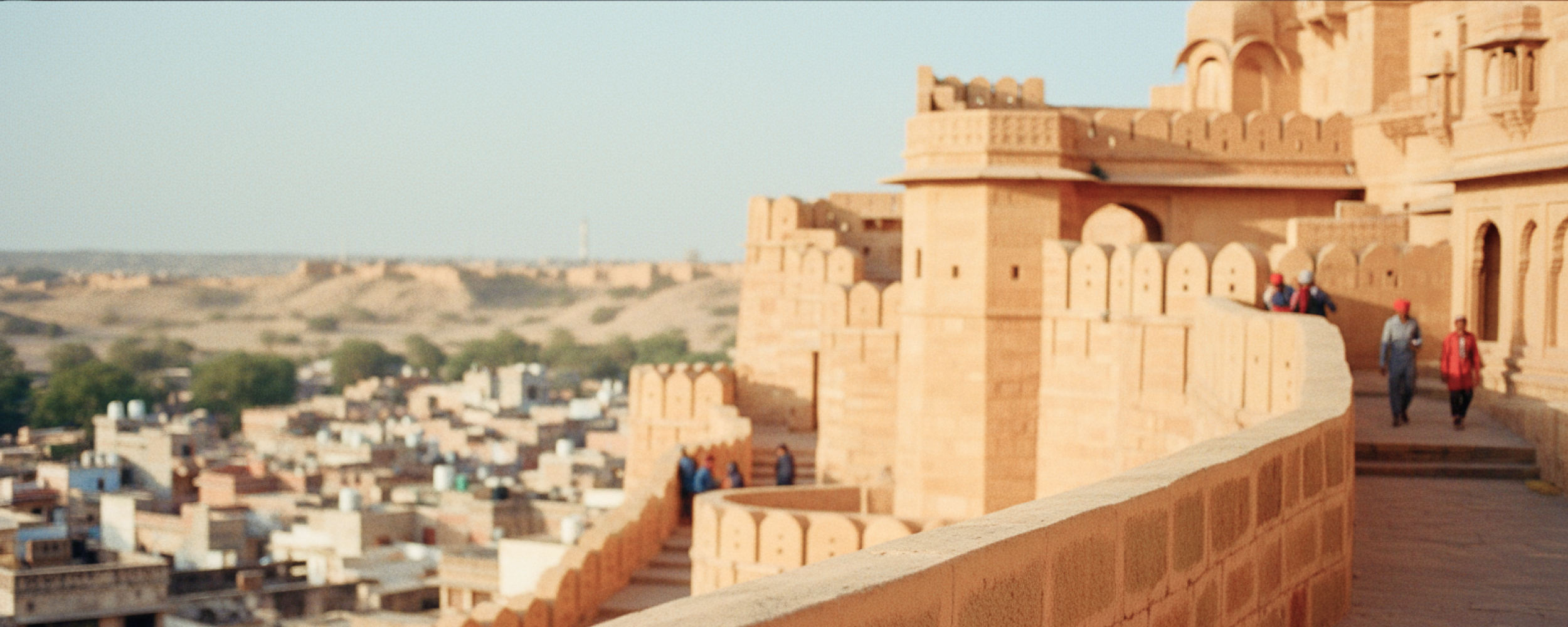
Unlike most Indian forts, which sit empty as monuments, Jaisalmer Fort is a living, breathing settlement. Around 3,000 people still call it home, which is precisely what makes it one of the most unique heritage sites in India. You’ll find havelis, Jain temples, shops, guesthouses, and rooftop cafés inside its golden sandstone walls. At sunset, the entire city glows amber — hence the name “Golden Fort.”
Getting to Jaisalmer Fort
- Entry fee: Free to enter the fort; ₹150 per person for the palace museum
- Timings: Fort open 24/7; palace museum 9:00 AM – 6:00 PM
- Transport: Jaisalmer Railway Station has overnight trains from Jodhpur and Jaipur. The fort sits about 2 km from the station — a short auto ride
- Food nearby: Trio Restaurant inside the fort offers a classic Rajasthani thali (₹250–₹400). Rooftop cafés along the fort walls serve chai and snacks for ₹50–₹100
Mysore Palace: Karnataka’s Most Magnificent Heritage Site
The Mysore Palace is everything you imagine an Indian royal palace to be, and then some. The Wadiyar dynasty used it as their official residence, and the current structure — built in the early 20th century — blends Hindu, Mughal, Rajput, and Gothic architectural styles. Inside, the stained glass ceilings, painted floors, and ornate halls are extraordinary. Additionally, during the Dasara festival in October, nearly 100,000 light bulbs illuminate the palace — it’s genuinely one of the most spectacular sights in the country.
Getting to Mysore Palace
- Entry fee: ₹200 for adults (includes audio guide in multiple languages); children under 10 enter free
- Timings: 10:00 AM – 5:30 PM daily; illuminated Sundays and public holidays 7:00–7:45 PM
- Transport: Mysore City Railway Station is about 2 km from the palace; taxis, autos, and city buses are readily available
- Food nearby: Hotel RRR near the palace is locally famous for Karnataka-style meals served on a banana leaf — budget ₹100–₹150
Ajanta and Ellora Caves: Maharashtra’s Ancient Heritage Sites
These two cave complexes near Aurangabad are extraordinary, though they reward travellers most when treated as separate visits. Ajanta is primarily Buddhist, with 30 rock-cut caves that contain some of the most breathtaking ancient frescoes in the world, painted between the 2nd century BCE and the 6th century CE. Ellora is larger and more diverse, featuring 34 caves that represent Buddhist, Hindu, and Jain traditions. In particular, the Kailasa Temple at Ellora — which builders carved entirely from a single rock — is mind-bending. Both sites carry UNESCO World Heritage status.
Getting to Ajanta and Ellora
- Ajanta entry fee: ₹600 for foreign nationals; ₹40 for Indian nationals
- Ellora entry fee: ₹600 for foreign nationals; ₹40 for Indian nationals
- Timings: Both sites 9:00 AM – 5:30 PM; Ajanta closes on Mondays, Ellora on Tuesdays
- Transport: MSRTC buses and shared taxis run to both sites from Aurangabad. Ajanta is 104 km away; Ellora is 30 km. A full-day taxi tour covering both typically costs ₹1,200–₹1,800
- Food nearby: MTDC canteens at both sites serve basic meals for ₹150–₹200
Khajuraho Temples: A World-Famous Heritage Site in Madhya Pradesh
The Khajuraho Group of Monuments is famous for its erotic sculptures, but that reputation doesn’t quite do justice to the full site. The Chandela dynasty built these temples between the 9th and 12th centuries, and they represent some of the finest examples of medieval Indian temple architecture anywhere. The sensual carvings are just one part of a broader iconographic programme that also includes gods, celestial beings, animals, and scenes from daily life. Together, the western group of temples — the most impressive and best preserved — forms a UNESCO World Heritage Site.
Getting to Khajuraho
- Entry fee: ₹600 for foreign nationals (western group); ₹40 for Indian nationals; eastern and southern groups are free or charge nominal fees
- Timings: Sunrise to sunset; sound and light show daily at 7:30 PM (₹250 for foreign nationals)
- Transport: Khajuraho has a domestic airport with flights to Delhi and Varanasi. Train connections from Mahoba link the town to major cities across India
- Food nearby: Raja Café near the western temples is a long-standing favourite among travellers, serving Indian and continental dishes for ₹200–₹400
Hampi: Karnataka’s Most Captivating Heritage Site
Hampi is genuinely unlike anywhere else in India. The ruined capital of the Vijayanagara Empire — once one of the largest cities in the world — spreads across a surreal, boulder-strewn landscape along the Tungabhadra River. Temples, royal enclosures, market streets, and elephant stables: the scale of what once stood here is staggering. Furthermore, the landscape itself feels almost otherworldly, with enormous granite boulders piled in formations that look almost engineered. It’s a UNESCO World Heritage Site, and it consistently ranks among the most iconic heritage sites in India for travellers who make the effort to get there.
Getting to Hampi
- Entry fee: ₹600 for foreign nationals for the main monuments; ₹40 for Indian nationals; several sites are free
- Timings: Most sites open 6:00 AM – 6:00 PM; Virupaksha Temple is open 24 hours
- Transport: The nearest major hub is Hospet (13 km), which has rail connections to Bengaluru and Hyderabad. Buses and autos run regularly between Hospet and Hampi. Overnight buses from Bengaluru to Hospet take about 7–8 hours
- Food nearby: The Hampi Bazaar area near Virupaksha Temple has several rooftop restaurants serving meals for ₹150–₹300. The Mango Tree Restaurant, by the river, is a local favourite
Pay Smarter at Every Heritage Site with Mony
Visiting these sites means juggling entry fees, auto rides, chai stops, train bookings, and the occasional guesthouse payment — and managing cash across multiple cities adds up quickly. That’s where Mony comes in. Simply top up your Mony account before your trip and make fast, secure payments wherever you go — whether you’re booking a sound-and-light show in Khajuraho or settling a restaurant bill in Mysore. India’s UPI payment system is widely accepted across the country, from major hotels to street food vendors. Mony gives you seamless access to UPI, so you can focus on exploring India instead of hunting for ATMs.
How to Plan Your Route Around India’s Iconic Heritage Sites
Most of these sites fit naturally into logical travel circuits. For instance, the Taj Mahal and Fatehpur Sikri both sit within easy reach of Agra, and Delhi — just a short train ride away — gives you access to the Red Fort and Qutub Minar. Similarly, Ajanta and Ellora sit close to Aurangabad and work well as a two-day combination. Meanwhile, Hampi and Mysore are both in Karnataka, making them a natural pairing on a southern India circuit. Konark and Khajuraho require more dedicated detours, but both are well worth the effort.
Above all, India rewards travellers who move slowly. A week at any of these iconic heritage sites in India would barely scratch the surface — the more time you invest, the more each place gives back.
Leave a Reply