
Discovering Spiritual Jaipur: 7 Famous Temples Every Foreigner Must Visit
Table of Contents
Jaipur’s spiritual heritage is as rich as its architectural one. The temples to visit in Jaipur range from a white marble sanctuary at the base of a hill to an ancient pilgrimage complex with natural springs on the city’s edge. Several sit inside or adjacent to Jaipur’s most significant forts and palaces. Consequently, a single day can combine heritage sightseeing with genuine religious experience. This guide covers the seven most worthwhile, with practical information for each.
Birla Mandir — White Marble and City Views
Birla Mandir, also known as Laxmi Narayan Temple, sits at the base of Moti Dungri Hill in central Jaipur. The Birla Foundation completed it in 1988 using entirely white marble. The temple honours Lord Vishnu and Goddess Laxmi. Interior panels depict scenes from Hindu scripture alongside quotes from other religious traditions, giving it an inclusive character unusual in older sites. Entry is free. The temple opens daily from 6:00 AM to 12:00 PM and 4:00 PM to 9:00 PM. The terrace offers panoramic views of Jaipur, particularly striking after sunset.
Govind Dev Ji Temple — Krishna in the City Palace
Govind Dev Ji Temple sits within the City Palace complex and ranks among the most actively worshipped temples to visit in Jaipur. Maharaja Sawai Jai Singh II brought the idol of Lord Krishna from Vrindavan in the 18th century. The temple operates on a darshan schedule with several sessions daily from early morning to late evening. Entry is free. Check the current schedule at the City Palace entrance. During Janmashtami, the celebrations here draw large crowds from across Rajasthan and are among the most elaborate in the state.
Moti Dungri Ganesh Temple — Hilltop Pilgrimage
Moti Dungri Ganesh Temple crowns the Moti Dungri Hill beside Birla Mandir. It honours Lord Ganesha and attracts particularly large devotional crowds on Wednesdays. The climb from the base takes 10 to 15 minutes. Entry is free. The temple opens from 5:00 AM to 1:00 PM and 4:30 PM to 9:30 PM. During Ganesh Chaturthi in August or September, vendors and decorations fill the entire hillside, making a visit worthwhile even for non-religious visitors.
Galtaji — The Monkey Temple on the Outskirts
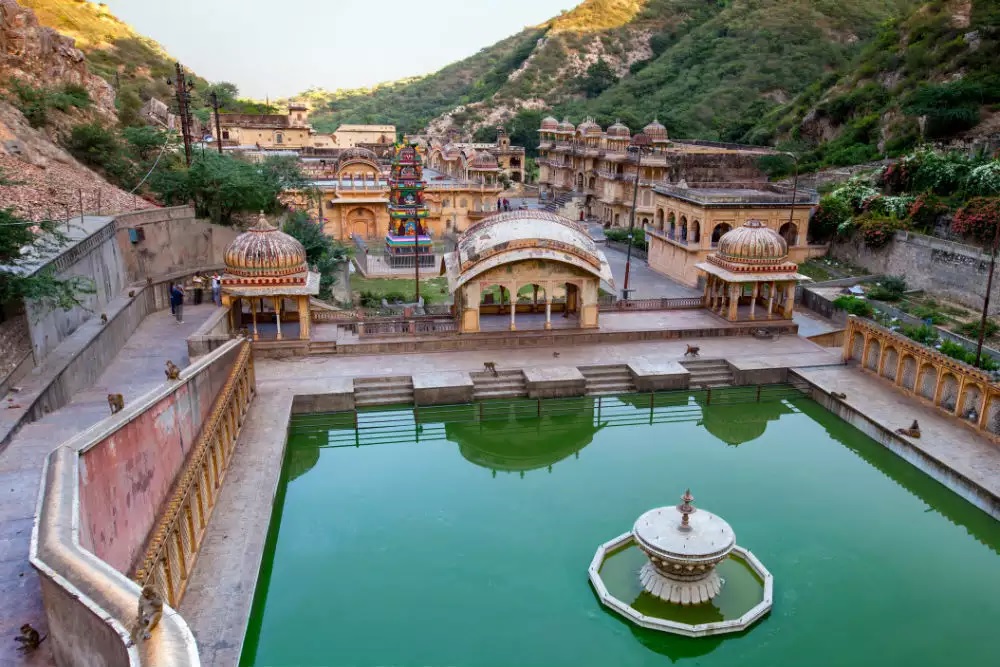
Galtaji is an ancient pilgrimage complex approximately 10 kilometres east of central Jaipur, set into a rocky gorge in the Aravalli Hills. Natural springs feed a series of sacred kunds (water tanks) where pilgrims bathe. Several hundred resident monkeys move freely through the temples and along the hillside paths. The complex includes multiple temples from different periods, with the Surya Temple at the top offering the best views. Entry is free. The complex opens from dawn to dusk. A cab from central Jaipur costs approximately Rs 250 to Rs 350 one way. Remove footwear before entering the main temple areas.
Shila Devi Temple — Goddess Durga inside Amber Fort
Shila Devi Temple sits within Amber Fort and honours Goddess Durga. Maharaja Man Singh I brought the idol from Jessore (now in Bangladesh) in the late 16th century following a military victory. The silver door panels and inner sanctum decoration are among the most elaborate of all the temples to visit in Jaipur. Entry comes with the Amber Fort ticket — Rs 100 for Indian nationals and Rs 550 for foreign visitors. During Navratri, the temple draws large devotional gatherings and the atmosphere of the fort changes considerably.
Jagat Shiromani Temple — Amber’s Most Intricate Carvings
Jagat Shiromani Temple in the Amber area dates to the early 17th century. It honours Lord Krishna, Meera Bai, and Lord Vishnu. The carved stone panels depicting scenes from the Ramayana and Mahabharata are among the finest examples of this craft in the Jaipur region. An idol here is believed to have belonged to Meera Bai herself. Entry is free. The temple sits a short walk from the Amber Fort complex, making it a natural addition without requiring separate transport.
Govardhan Nath Ji Temple — Everyday Spiritual Life
Govardhan Nath Ji Temple in the old city honours Lord Krishna and follows the Vallabhacharya devotional tradition. It is one of the quieter temples to visit in Jaipur — less oriented toward tourism and more reflective of everyday Jaipuri religious practice. Entry is free. The surrounding lanes carry small food vendors where a glass of chai costs Rs 15 to Rs 20.
Practical Tips for Visiting Jaipur’s Temples
Dress modestly at all temples — shoulders and knees should be covered. Remove footwear before entering any inner sanctum. Photography policies vary by temple and by section within a complex — ask before raising a camera. Most temples are most active between 6:00 AM and 9:00 AM and again in the early evening. Auto-rickshaws from the city centre to Galtaji and the Amber Fort area cost Rs 100 to Rs 200 per journey.
For NRI visitors and international tourists, Mony handles all local payments across a temple trail day seamlessly. Mony is a travel finance app that lets NRIs and tourists pay like locals using UPI. As a result, auto fares, prasad purchases, food stall snacks, and monument entry fees all settle in a single scan — no foreign card fees and no need for exact change.




Leave a Reply