
The Ultimate Workshop Guide for Foreign Tourists in Jodhpur: Learn, Create & Explore
Why Jodhpur’s Workshop Scene Deserves a Spot on Your Itinerary
Jodhpur is more than its famous blue skyline and fortress silhouettes. Beneath all that grandeur is a city quietly humming with craftspeople who’ve been perfecting their trades for generations. If you’re the kind of traveller who’d rather make something than just photograph it, the cultural workshops in Jodhpur will be the highlight of your trip — no question about it.
And the good news? Getting to them, paying for them, and buying what you make has never been easier. Mony — a UPI wallet designed with international travellers in mind — lets you link your overseas debit or credit card and pay seamlessly across workshops, markets, and restaurants. No fumbling for cash, no currency confusion.
Here’s a workshop-by-workshop breakdown of what to expect.
Block Printing Workshops: Where Fabric Meets Tradition
Few crafts are as visually satisfying as block printing, and Rajasthan is one of the best places in the world to learn it. In a typical session, you’ll be handed hand-carved wooden blocks, a tray of natural dyes, and a plain piece of fabric — then guided through the meditative process of stamping precise patterns, row by row.
By the end of a two-to-three-hour workshop, you’ll have created a scarf, tote bag, or wall hanging that’s genuinely yours. Most workshops in the old city cluster around Sardar Market and the lanes near Mehrangarh Fort.
Practical Info
- Duration: 2–3 hours
- Price: ₹100-₹250 for Indians and ₹600-₹700 for foreign visitors (materials usually included)
- Best time to visit: Morning sessions (9 AM–12 PM) tend to be cooler and less crowded
- Getting there: Auto-rickshaw from Jodhpur Railway Station to the Clock Tower area costs approximately ₹50–₹80. The fort is a further 10-minute walk uphill.
Pottery Workshops: Getting Your Hands Properly Dirty
There’s something deeply calming about sitting at a potter’s wheel. The clay does what it wants until, slowly, it doesn’t — and that moment when a shape starts to emerge under your hands is genuinely hard to forget.
Jodhpur’s pottery workshops are typically run out of small family studios, often in the quieter lanes around Pal Haveli and surrounding neighbourhoods. You’ll learn to centre, throw, and glaze under the guidance of a local artisan. Most pieces need to be fired, so expect to either arrange shipping or pick up a pre-made piece as a memento.
Practical Info
- Duration: 2–4 hours
- Price: ₹700–₹1,500 per person
- Note: Wear clothes you don’t mind getting clay on — aprons are usually provided but never quite enough
- Getting there: Most studios are reachable by auto-rickshaw; negotiate a fare from Ghanta Ghar (Clock Tower) for around ₹40–₹60
Jutti Making: Walk Away With a Story on Your Feet
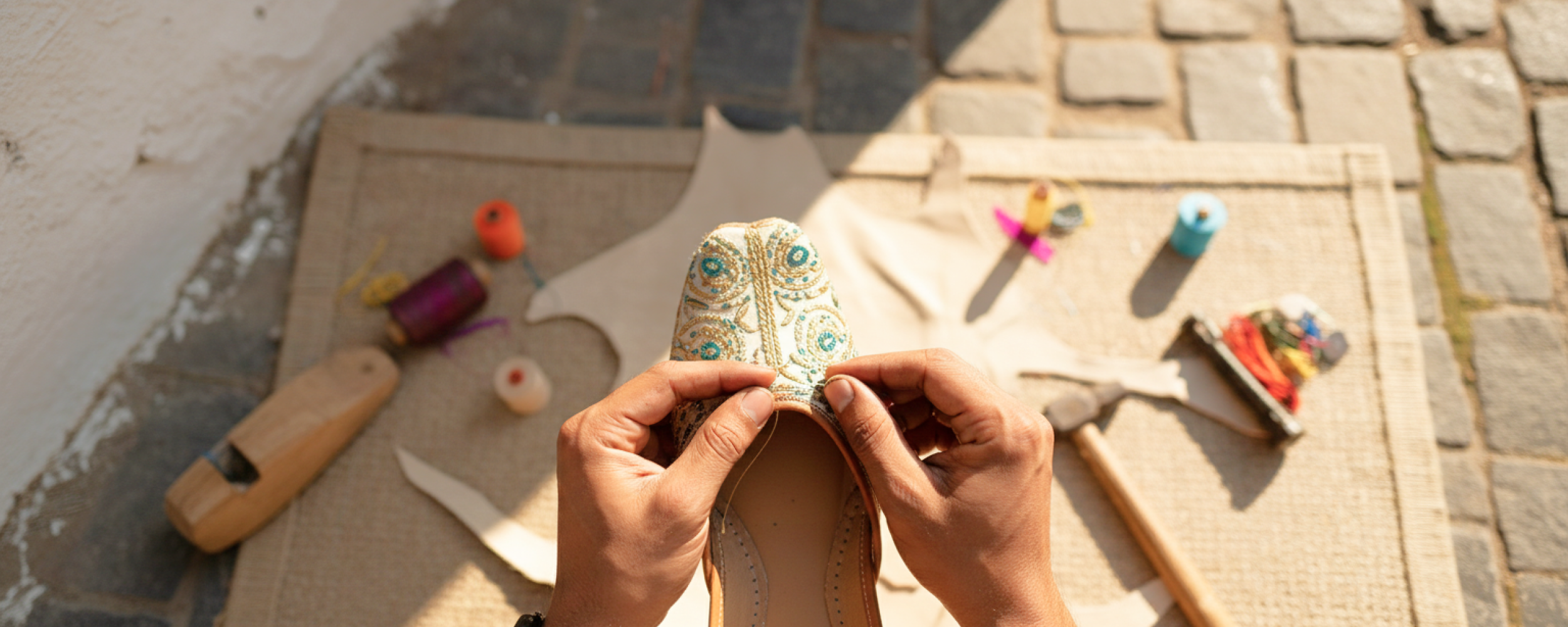
Juttis — those flat, embroidered leather shoes that look too beautiful to actually wear — are one of Rajasthan’s most iconic crafts. The embroidery alone can take hours of skilled work, and a jutti-making workshop gives you a genuine window into that process.
You won’t be making a full pair from scratch (that takes days), but you’ll learn the stitching techniques, understand the symbolism behind common motifs, and often get to personalise a pre-formed upper with your own embroidery. Several workshops are based near Mochi Market, the traditional cobblers’ quarter in the old city.
Practical Info
- Duration: 1.5–3 hours
- Price: ₹600–₹1,000 per person
- Timings: Most workshops run 10 AM–6 PM; booking ahead is recommended
- Getting there: Mochi Market is a short auto-rickshaw ride from Sardar Market; fares from the city centre are around ₹40–₹60
Painting Workshops: Rajasthani Miniatures in Your Own Hands
Rajasthani miniature painting is an art form that rewards patience. The detail is extraordinary — figures no larger than a thumbnail, rendered with brushes made from a single squirrel hair, layered with natural pigments and gold leaf.
Painting workshops in Jodhpur typically start with an introduction to the miniature tradition before moving on to more accessible techniques that beginners can actually enjoy. You’ll leave with a small artwork on paper or ivory-coloured card that holds up surprisingly well compared to most souvenir shop alternatives. Look for workshops near Toorji Ka Jhalra (Stepwell), one of the city’s most beautiful restored landmarks, surrounded by art studios and rooftop cafés.
Practical Info
- Duration: 2–4 hours
- Price: ₹800–₹2,000 per person depending on materials and complexity
- Timings: 9 AM–5 PM most days
- Getting there: Toorji Ka Jhalra is free to enter and walkable from Ghanta Ghar (Clock Tower) in about 10 minutes
Tie-Dye Workshops: Bandhani and Beyond
Rajasthan’s tie-dye tradition — known locally as bandhani — produces some of the most vivid textiles you’ll find anywhere. Tiny sections of fabric are pinched and bound with thread before dyeing, creating intricate dot patterns in dazzling combinations of red, yellow, green, and deep indigo.
Workshops will have you tying your own piece before it goes into the dye bath — and there’s something genuinely exciting about unravelling the knots to see the pattern emerge. The whole process takes a few hours and you’ll go home with a dupatta, saree border, or piece of fabric you made yourself.
Practical Info
- Duration: 2–3 hours
- Price: ₹500–₹900 per person
- Timings: Morning sessions recommended; some workshops near Sardar Market run walk-in sessions daily
- Note: Natural dyes can stain — gloves are provided, but watch your clothes
Cooking Classes: The Flavours of Rajasthan, From Scratch
You could eat dal baati churma every day in Jodhpur and not get bored — but understanding how it’s made turns it into something else entirely. Rajasthani cooking workshops are some of the most rewarding experiences in the city, partly because the cuisine is so distinct from other Indian regional cooking, and partly because the spice combinations are genuinely complex.
A typical class covers two to four dishes: often something like ker sangri (desert beans with dried berries), gatte ki sabzi (chickpea flour dumplings in a spiced gravy), and a sweet like malpua. Classes are usually run out of home kitchens and small guesthouses, with several options clustered near Umaid Bhawan Palace.
Practical Info
- Duration: 3–4 hours (including eating what you’ve made)
- Price: ₹1,200–₹2,500 per person
- Timings: Morning (9–10 AM start) and evening (4–5 PM start) sessions available
- Getting there: Most cooking class venues arrange pickup from your hotel; otherwise, an auto-rickshaw from Jodhpur Railway Station runs ₹80–₹120 to the Umaid Bhawan area
Where to Eat Nearby
If you’d rather sample the local cooking scene before committing to a class, head to Indique Restaurant & Bar at Pal Haveli for rooftop views of Mehrangarh Fort and Rajasthani thalis (₹350–₹700). For something quicker and cheaper, Shahi Samosa Arora Namkeen near the Clock Tower does legendary pyaaz kachoris and their signature shahi samosa for ₹20–₹40 each — arrive early, the good stuff sells out.
Getting Around Jodhpur for Workshops
Jodhpur doesn’t have a metro. Your main options are:
- Auto-rickshaws — the default. Negotiate fares before getting in; most rides within the old city are ₹40–₹100.
- Ola/Uber — available and generally more predictable on pricing.
- Walking — the old city is genuinely walkable if you’re based near the Clock Tower. Most craft workshops are within a 15-minute walk of Ghanta Ghar.
- Nearest railway: Jodhpur Junction connects to Jaipur (4–5 hours), Delhi (10–12 hours), and Mumbai (18 hours).
Paying for Everything With Mony
Here’s the practical bit that most travel guides skip over: carrying enough cash to cover workshops, tips, snacks, and spontaneous souvenir purchases in Jodhpur is genuinely inconvenient. ATMs exist but they’re not always reliable, and many smaller workshops now prefer digital payments.
Mony solves this cleanly. It’s a UPI-enabled wallet built for international visitors — you link your foreign debit or credit card, load the wallet, and pay via UPI anywhere it’s accepted, which in Jodhpur covers most workshops, markets, and restaurants. No transaction theatre, no hunting for change. Just tap and go.
It’s particularly useful when you’re doing cultural workshops in Jodhpur, where it’s easy to add on extras — an extra scarf to print, a second pottery piece to glaze — without worrying whether you have the right notes on you.
Download Mony before your trip, get set up before you land, and the payments side of your Jodhpur experience essentially takes care of itself.

Leave a Reply